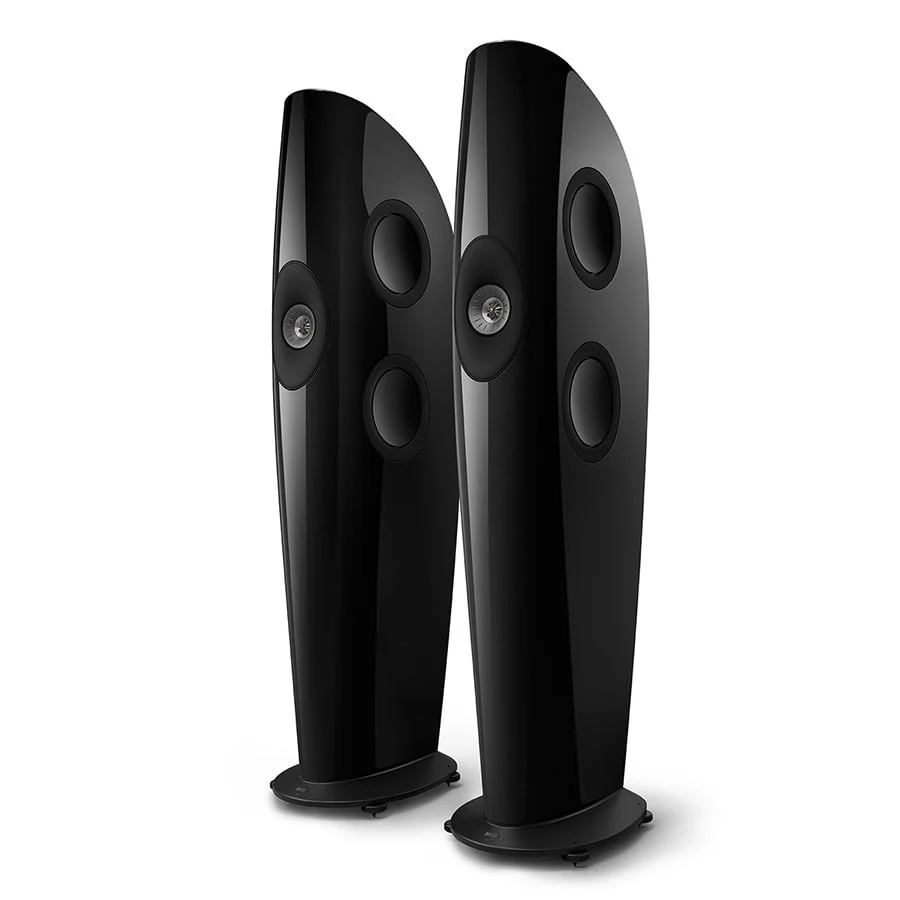

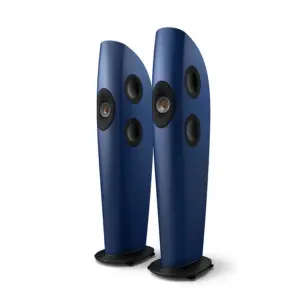
Most loudspeakers ask the ear to assemble a performance from parts: a tweeter above, a woofer below, and a crossover stitching the two together somewhere in between. The KEF Blade One Meta removes the seams. Four bass drivers, a midrange cone and a tweeter are arranged so that every frequency, from the lowest organ pedal to the air around a cymbal, appears to leave the cabinet from one point in space. The result is a soundstage of rare stillness and scale, from a loudspeaker that reads as sculpture long before the first note plays.
One Point in Space
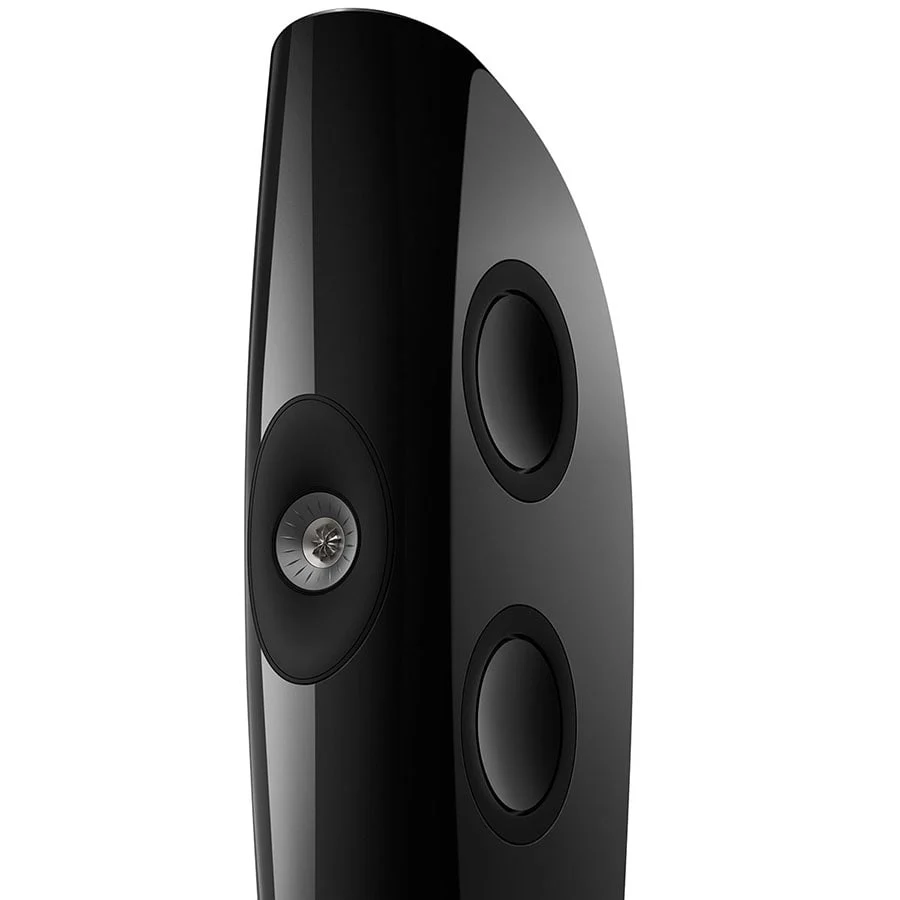
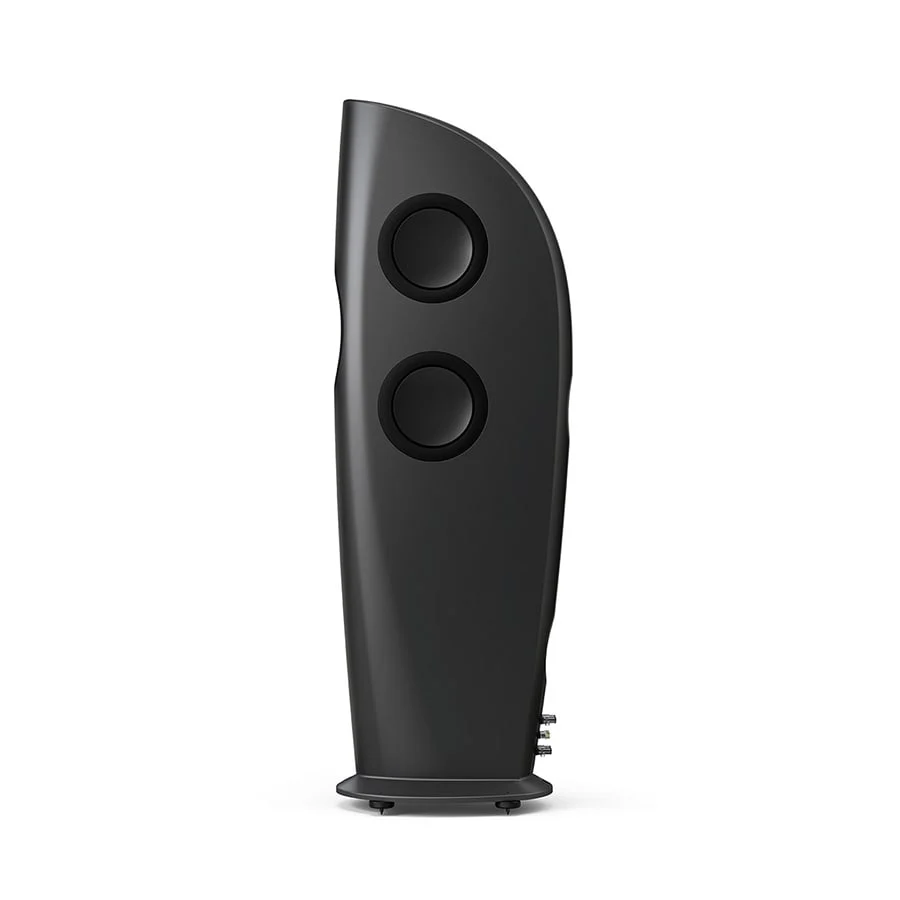
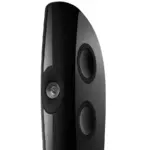
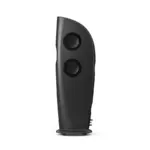
Uni-Q is the signature of modern KEF design: a tweeter nested in the centre of a midrange cone so precisely that treble and midrange share a single acoustic origin. Blade carries that principle across the entire spectrum. Two bass drivers sit on each flank of the slender cabinet, one above and one below the Uni-Q array, arranged so symmetrically that at a normal listening distance all four merge with the midrange and treble into what KEF calls a Single Apparent Source. Instruments hold position with remarkable precision, voices keep full body, and the stereo image stays whole from seats well away from the centre of the room.
A Uni-Q Array Built for Blade
The Uni-Q array inside the KEF Blade One Meta is a bespoke twelfth-generation design, with tweeter and midrange both developed from the ground up for KEF’s flagship loudspeakers. A stiffened, vented aluminium tweeter dome sits behind KEF’s patented Tangerine waveguide, which spreads high frequencies evenly into the room. Around the tweeter, a new midrange motor places a copper ring within the magnetic gap to lower distortion and thermal compression, while a flexible decoupling chassis keeps vibration from the midrange and treble motors away from the cabinet. The contours of dome, horn and surround are computer-optimised to meet the cabinet without a step, and the treble stays sweet and lucid at any volume.
Silence Behind the Tweeter
A tweeter dome radiates sound from the rear as well as the front, and in a conventional design that rear wave is reflected back through the dome as a faint haze of distortion. The KEF Blade One Meta answers with Metamaterial Absorption Technology: a small disc of intricate, maze-like channels, developed with the Acoustic Metamaterials Group, each channel tuned to absorb a narrow band of frequencies. Together the channels soak up almost all of the unwanted rear energy. What remains is treble of unusual purity, with sibilance free of glare, cymbals allowed a full natural decay and a background quiet enough for the smallest detail to register.
Bass That Leaves the Cabinet Still
Bass is where large loudspeakers usually give the game away, through enclosures that hum in sympathy with the music. In the KEF Blade One Meta, each pair of bass drivers is bonded back to back through the cabinet, so the reactive force of one cone is cancelled by the cone opposite. KEF staff demonstrating Blade often stand a coin on edge at the crest of the cabinet and play wide-bandwidth music at high level; the coin stays upright. Each pair occupies a separate chamber, reducing interference between the drivers and the need for damping that would dull the low end, while decoupled diaphragms permit gentle, low-order crossovers and vented couplers let trapped air escape however hard the drivers work. The reward is bass of real weight and depth that starts and stops with the music rather than lingering behind the beat.
Sculpted by Acoustics
The silhouette of the KEF Blade One Meta follows the engineering rather than decorating the result. Single Apparent Source asks for the bass drivers to sit as close to the Uni-Q array as possible, which calls for a slim profile, and the curves that follow present no sharp edges to scatter sound. KEF’s designers worked with Eric Chan of ECCO Design in New York, drawing the parabolic form from Brancusi’s Bird in Space sculptures. The cabinet tapers from top to bottom and from front to back, and a dense, acoustically inert composite gives the complex curves the stiffness to keep standing waves from blurring the sound. Each cabinet weighs 57.2 kilograms, yet the form reads as a single gesture rather than a box. Every pair of KEF Blade speakers is designed, engineered and handcrafted at KEF’s home in Maidstone, Kent.
A Lineage Begun Without Limits
Among KEF flagship speakers, Blade has a singular origin. In 2009 KEF gave a team of engineers free rein to build a loudspeaker without preconceptions, and the result, Concept Blade, made a public debut in Munich as the world’s first Single Apparent Source design. A production Blade followed, then a smaller Blade Two, and today the KEF Blade Meta range comprises two models sharing one technology and one striking silhouette. The KEF Blade One Meta is the larger: bigger bass drivers in a taller cabinet bring greater authority to the foundation of the music, while the smaller Blade Two Meta scales the same idea to more modest rooms.
Partnering and Placement
Amplification deserves as much care as the loudspeakers. KEF specifies a broad window of amplifier power and is candid that a small amplifier driven into distortion poses more risk than a larger design with power in reserve. Two pairs of WBT terminals allow single-wiring, bi-wiring or bi-amplification, so a system can grow with ambition. In the room, the wide dispersion of Uni-Q means the KEF Blade One Meta speakers can begin facing straight ahead with no toe-in, set generously apart and clear of corners, with the listening seat at least as far back as the loudspeakers are spaced. Adjustable spikes, floor-protecting pucks and a spirit level at the rear of each cabinet make fine levelling straightforward, and KEF recommends that a trained retailer commission each pair rather than an owner levelling a cabinet single-handed.
Hearing the KEF Blade One Meta on Wigmore Street
A loudspeaker of this scale is best judged in person, with music you know intimately. Enquire with Audio Lounge on Wigmore Street to arrange a private audition of the KEF Blade One Meta and to talk through partnering amplification, room placement and finish, from the gloss and matte satin standards to a cabinet matched to any Pantone colour you choose.
About KEF
KEF was founded in 1961 by Raymond Cooke, a devoted music lover convinced that recordings could return the immersion of a live performance to the home, provided the science was right. From Maidstone, Kent, KEF became the first to apply computer analysis to loudspeaker performance, borrowing finite element modelling from aerospace, and pioneered driver decoupling and precise pair matching along the way. The Uni-Q driver array grew into the building block of the modern KEF sound, and Metamaterial Absorption Technology, developed with the Acoustic Metamaterials Group, brought a new material science to the tweeter. Blade remains the fullest expression of that lineage and is still designed and handcrafted in Maidstone. Explore the KEF collection at Audio Lounge on Wigmore Street.
Questions About the KEF Blade One Meta
What is the KEF Blade One Meta?
The KEF Blade One Meta is a three-way passive floorstanding loudspeaker and the flagship model of KEF’s Blade range. Four force-cancelling 225mm bass drivers surround a bespoke twelfth-generation Uni-Q array with Metamaterial Absorption Technology, arranged so that every frequency appears to come from one point. KEF designs, engineers and handcrafts Blade in Maidstone, Kent, and the KEF Blade One Meta is supplied as a pair.
How does Single Apparent Source technology work?
Single Apparent Source makes every frequency appear to radiate from one point. A Uni-Q array, which seats the tweeter in the acoustic centre of the midrange cone, sits between four identical bass drivers placed equidistantly around the array on both flanks of the cabinet. At a normal listening distance the bass drivers merge with the Uni-Q into one apparent source, so the KEF Blade One Meta images precisely and holds tonal balance across a wide seating area.
What does Metamaterial Absorption Technology do?
Metamaterial Absorption Technology removes the distortion caused by sound radiating from the back of the tweeter dome. A maze-like disc of 30 tuned channels, developed with the Acoustic Metamaterials Group, absorbs 99% of that rear energy rather than letting the wave reflect back through the dome. In the KEF Blade One Meta the absorber partners a vented, stiffened aluminium dome. MAT was named What Hi-Fi? Innovation of the Year in 2020.
How deep does the bass of the KEF Blade One Meta go?
To about 20Hz in a typical room. KEF quotes an in-room bass response of 20Hz at -6dB, a free-field range of 27Hz to 45kHz at -6dB and a frequency response of 35Hz to 35kHz within ±3dB. Four 225mm aluminium-cone bass drivers in force-cancelling pairs deliver that extension with minimal cabinet colouration, so low notes arrive with weight and definition rather than boom.
What amplifier does the KEF Blade One Meta need?
An amplifier rated between 50 and 400 watts suits the KEF Blade One Meta. Nominal impedance is 4 ohms with a 2.8-ohm minimum, and sensitivity is 88dB at 2.83V/1m, so choose an amplifier comfortable with low impedances. KEF advises that a larger amplifier with power in reserve is safer than a small one driven into distortion, particularly with generous bass or loudness settings.
Can the KEF Blade One Meta be bi-wired or bi-amplified?
Yes. The KEF Blade One Meta has two pairs of silver-plated WBT terminals, allowing single-wiring with the links in place, bi-wiring, or bi-amplification with separate amplifier channels for the high-frequency and low-frequency sections. The terminals accept bare wire, spade connectors or 4mm plugs. KEF recommends high-quality cable, runs of equal length for both channels, and keeping those runs as short as practical to preserve level balance and focus.
How should the KEF Blade One Meta be positioned?
Place the pair two to three metres apart, at least 225mm from the wall behind and more than a metre from the side walls, and sit between 1 and 1.2 times that spacing from the pair. Start facing straight ahead: the wide dispersion of Uni-Q suits no toe-in, and up to 15 degrees can sharpen the centre image at some cost to width. Level each cabinet with the supplied spikes and spirit level.
How large and heavy is the KEF Blade One Meta?
Each cabinet of the KEF Blade One Meta measures 1590mm high, 363mm wide and 540mm deep with the plinth fitted, and weighs 57.2kg. The speakers ship one per carton, and KEF advises two able-bodied people for lifting and against levelling a cabinet single-handed. Supplied items include a plinth set, spikes with locking nuts, floor-protecting pucks, speaker port bungs, a cleaning cloth and a product build certificate.
What finishes are available for the KEF Blade One Meta?
There are eight standard finishes, each pairing a cabinet colour with a Uni-Q cone colour. In gloss: Piano Black/Copper, Piano Black/Grey, Racing Red/Grey and Arctic White/Champagne. In matte satin: Frosted Blue/Blue, Frosted Blue/Bronze, Charcoal Grey/Red and Charcoal Grey/Bronze. KEF will also finish the cabinet in any Pantone colour supplied, paired with a copper, grey, bronze, blue, red or champagne cone. Performance is identical across every finish.
How does the KEF Blade One Meta compare with the Blade Two Meta?
The KEF Blade One Meta is the larger and more capable of the two KEF Blade Meta models. Both share the same Uni-Q array with MAT, the same finishes and the same form; the Blade One Meta uses four 225mm bass drivers against the Blade Two Meta’s 165mm units, reaches 20Hz rather than 25Hz in a typical room, and offers 88dB rather than 86dB sensitivity. KEF positions the Blade Two Meta for smaller rooms.