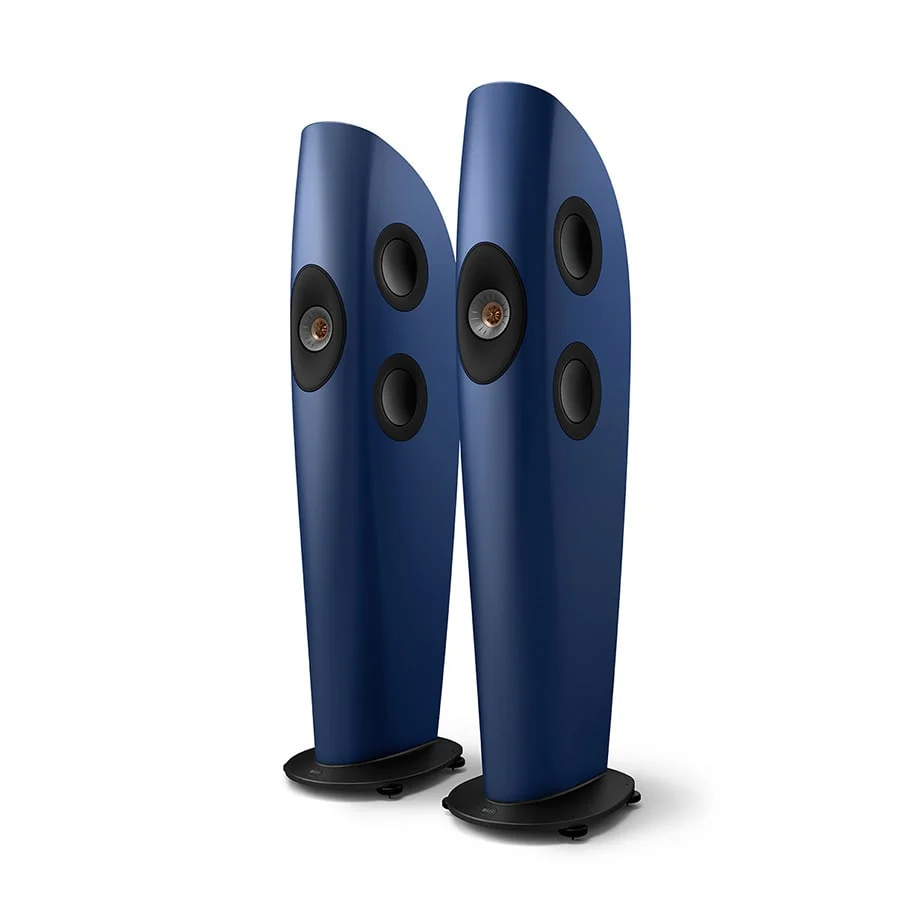
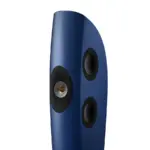
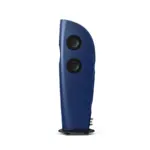
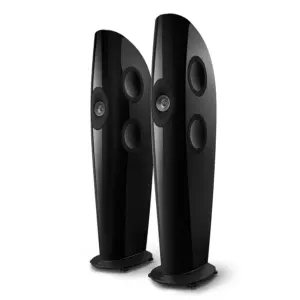
Not every listening room can accommodate a loudspeaker of full flagship proportions, and not every owner wishes to surrender a room to one. The KEF Blade Two Meta resolves both with the idea that defines KEF’s flagship Blade series: bass, midrange and treble all seem to emerge from one place, so a singer stands in the room as a single, solid presence rather than a sum of drivers. Four bass drivers flank a bespoke Uni-Q array in a slightly smaller cabinet, shaped more like sculpture than furniture, and the coherence that results is rare at any size.
Flagship Engineering, Scaled for the Room
KEF describes the Blade Two Meta in terms of shared DNA. The Uni-Q array is the same size as the one in the larger KEF Blade One Meta, Metamaterial Absorption Technology sits behind the tweeter in both models, and one sculptural silhouette and palette of finishes carries across the pair of designs. The difference lies in the bass section, where four smaller drivers occupy a cabinet that stands a little lower and a little slimmer. KEF’s own summary promises all of the acoustic prowess on a slightly smaller scale, and in 2022 the KEF Blade Two Meta took Stereophile’s Product of the Year award in the loudspeaker category.
Every Frequency from a Single Origin
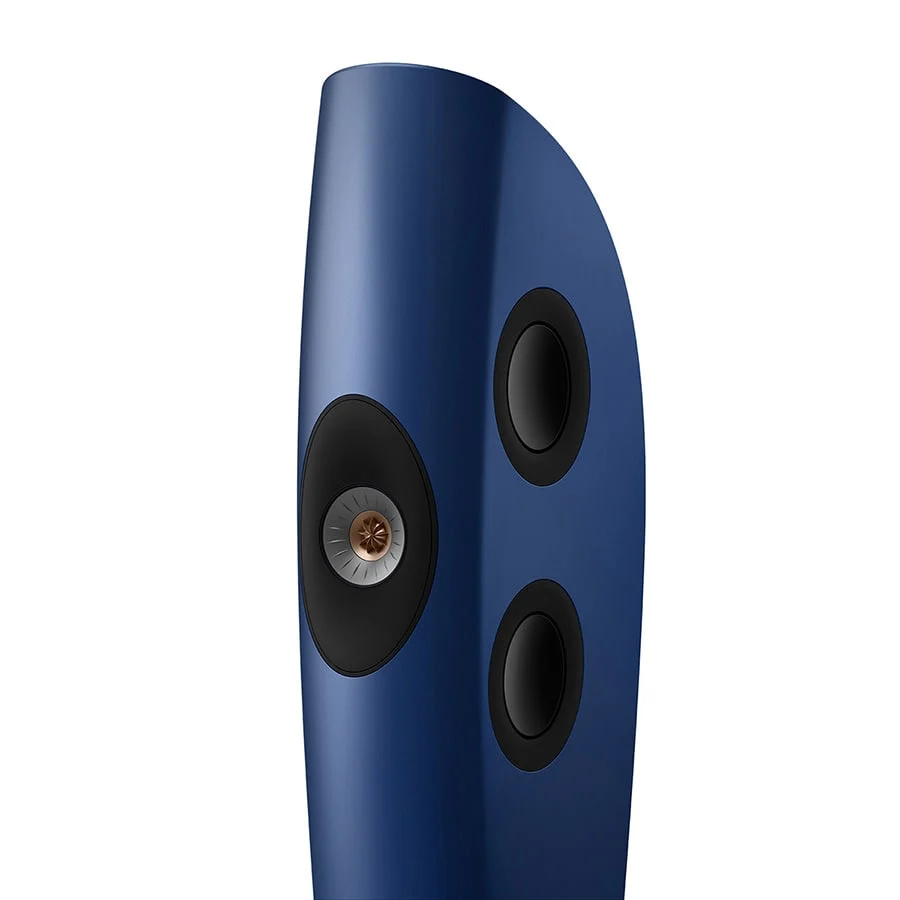
Conventional loudspeakers spread the music vertically: treble from one driver, midrange from another, bass from somewhere lower down the cabinet, with the ear left to reconcile the three. Uni-Q solves half of that problem by seating the tweeter within the throat of the midrange cone, so treble and midrange leave from one origin. Single Apparent Source, the principle KEF introduced with Concept Blade in 2009, carries the same logic into the bass. Two bass drivers are set into each side of the cabinet, one higher than the Uni-Q array and one lower, grouped so tightly and so symmetrically that from the listening seat all four fuse with the array into one acoustic point. Images lock into place across the soundstage, depth opens up behind the plane of the cabinets, and the tonal balance holds for a guest seated well away from the central axis.
A Uni-Q Developed for Blade
KEF developed the twelfth generation of Uni-Q specifically for Blade, and the KEF Blade Two Meta carries the full-size version of that array. Behind the aluminium tweeter dome, KEF re-engineered the gap damper to make room for a metamaterial absorber, and two rings of porous material tame resonances in the cavity. A copper ring set into the motor of the midrange driver lowers inductance so that distortion falls and the drive unit stays efficient when the music swells. A new surround permits longer cone travel without diffraction, while a flexible chassis isolates the whole array from the cabinet. Heard from the sofa, the gains add up to a midrange of unusual candour, voices free of boxy colouring, and treble that remains sweet at a whisper and composed at full scale.
Treble Without a Shadow
Every tweeter dome radiates backwards as well as forwards. Left unchecked, that rear wave rebounds inside the driver and lays a faint grain over the treble, the kind of flaw noticed only once removed. Metamaterial Absorption Technology, developed by KEF with the Acoustic Metamaterials Group, places a maze-like absorber behind the dome. Each channel within the maze is shaped to absorb one band of frequencies, and together the channels behave like an acoustic black hole. On the KEF Blade Two Meta the effect registers as air and ease: strings with a natural sheen, sibilance without edge, and reverberant tails that fade into a genuinely quiet background.
Bass in Balanced Opposition
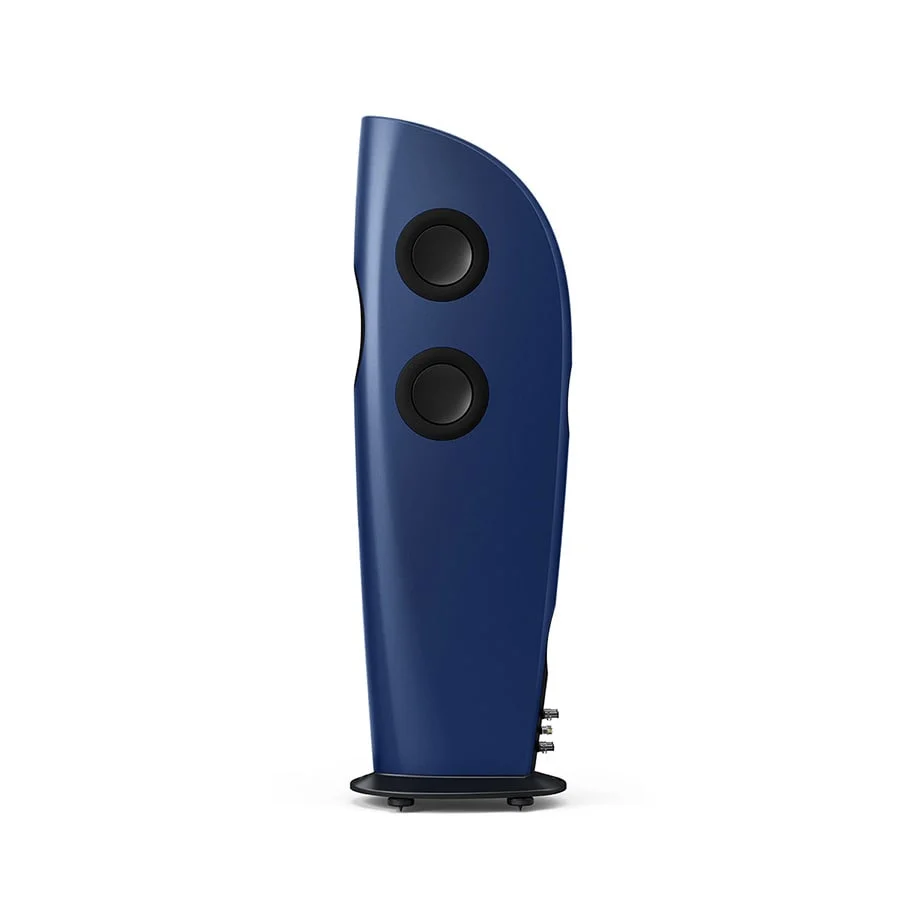
Deep bass from a slender floorstander normally comes at a cost: the cabinet flexes, and the music acquires a boom that belongs to the furniture rather than the recording. The KEF Blade Two Meta cancels the problem at source. The bass drivers are mounted back to back in opposing pairs, so the push of each cone is met by an equal and opposite push from the partner across the cabinet, and the enclosure stays inert however hard the music drives. Each pair sits in a dedicated chamber, which curbs interference between drivers and reduces the damping material that would otherwise soften the low end. Decoupling the voice coil from the diaphragm allows gentle crossover slopes, so the bass joins the Uni-Q array without a seam. A double bass keeps a woody grain, a kick drum lands with snap and stops cleanly, and the foundation of an orchestra feels solid rather than inflated.
A Silhouette with a Purpose
The profile of the KEF Blade Two Meta owes as much to physics as to taste. Keeping the bass drivers tight against the Uni-Q array demands a narrow body, and a narrow body invites curves: the cabinet narrows towards the crown and towards the rear, and the gentle front radius offers no edge to scatter sound. For the original form KEF engaged Eric Chan of the New York studio ECCO Design, and the two teams took their cue from Constantin Brancusi’s Bird in Space. The shell is moulded from a dense, acoustically inert composite whose parabolic curves discourage standing waves, so little internal bracing is required. At 35.3 kilograms per cabinet the loudspeaker is substantial without being monumental, and KEF still builds every pair by hand in Maidstone, Kent, where the design and engineering also take place.
For Music and for Cinema
KEF intends Blade for stereo and home cinema alike, with one aim in both: to reproduce the recording as faithfully as possible. That makes the KEF Blade Two Meta as persuasive with the low-frequency effects of a film score as with a solo piano. Amplification deserves equal thought. KEF’s recommended power window is generous, and KEF’s own guidance favours an amplifier with power in reserve over a small design pushed into distortion. Twin pairs of WBT binding posts accept a single cable run, separate runs to the treble and bass sections, or a second amplifier altogether, so the system can develop in stages, and Audio Lounge can advise on partnering amplifiers from the brands on demonstration.
A Private Audition on Wigmore Street
Scale, room and finish are decisions best made with the loudspeakers playing. Audio Lounge welcomes enquiries about the KEF Blade Two Meta, whether the question is how the pair will fill a particular room, which amplifier will do the pair justice, or which of the eight standard finishes suits the space, including a cabinet colour matched to any Pantone reference. Bring recordings you know well and judge the difference for yourself.
About KEF
KEF began in 1961 in Maidstone, Kent, where founder Raymond Cooke set out to bring the immersion of live music into ordinary homes through recordings. Cooke believed the task demanded science as much as ears, and wrote that KEF should return music to the ear and mind “without drama, without exaggeration, without artifice”. That conviction produced the Model 104 in 1973, the first of The Reference loudspeakers, and in time Uni-Q, the concentric driver that became the building block of the KEF sound. Blade gathers those threads into a single sculptural statement, drawn, engineered and built by hand in Maidstone to this day. Browse the full Audio Lounge KEF collection, from compact wireless designs to floorstanding loudspeakers built for dedicated rooms.
Questions About the KEF Blade Two Meta
What is the KEF Blade Two Meta?
A passive three-way floorstanding loudspeaker sold in pairs, the KEF Blade Two Meta is the smaller of the two models in KEF’s flagship Blade series. Four 165mm force-cancelling bass drivers surround a Uni-Q array fitted with Metamaterial Absorption Technology, the whole configured as a Single Apparent Source: bass, midrange and treble reach the ear as though from a single point. KEF designs and handcrafts every pair in Maidstone, Kent.
How does the KEF Blade Two Meta compare with the Blade One Meta?
Both share one Uni-Q array, one MAT absorber, one palette of finishes and one sculptural form; the bass section is where the two part. Four 165mm drivers replace the 225mm units behind the KEF Blade One Meta‘s deeper reach, so in-room bass reaches 25Hz rather than 20Hz, sensitivity is 86dB against 88dB, and each cabinet weighs 35.3kg rather than 57.2kg. KEF places the smaller model in rooms where nothing less than Blade performance will do.
Will the KEF Blade Two Meta suit a smaller room?
Yes. KEF describes the KEF Blade Two Meta as ideal for smaller rooms. Each cabinet stands 1461mm high, 338mm wide and 475mm deep including the plinth, and weighs 35.3kg. Four 165mm bass drivers reach 25Hz in a typical room without overwhelming a modest space, while Uni-Q’s broad, even dispersion keeps the balance consistent across a sofa. Corners and positions close to a side wall still weaken the stereo image, so allow clearance.
How low does the KEF Blade Two Meta go?
To around 25Hz in a typical room. KEF’s figures give 25Hz in-room at -6dB, 30Hz to 45kHz in free field at -6dB, and 33Hz to 35kHz within ±3dB. Four 165mm aluminium-cone drivers in back-to-back pairs, each pair in a separate chamber, provide that depth while the cabinet stays still, so organ pedals and synthesiser lines arrive with definition rather than bloom.
Which amplifier suits the KEF Blade Two Meta?
Any quality amplifier delivering 50 to 400 watts falls within KEF’s recommendation for the KEF Blade Two Meta. With 86dB sensitivity at 2.83V/1m and a 4-ohm nominal load that dips to 3.2 ohms, the pair rewards an amplifier with generous current delivery. Peak output reaches 116dB at one metre. KEF cautions that an underpowered amplifier driven into clipping endangers the drivers more than a larger design used sensibly.
What is a point source loudspeaker?
A point source loudspeaker radiates every frequency from one acoustic location, as a single voice or instrument does in life. Most multi-driver designs spread sound across separate drivers, which the ear hears as slightly displaced origins. The Uni-Q array achieves a point source for midrange and treble; Single Apparent Source in the KEF Blade Two Meta extends the effect to the bass by grouping four drivers symmetrically around that array.
What changed from the original KEF Blade Two?
The Meta generation added Metamaterial Absorption Technology behind the tweeter, a twelfth-generation Uni-Q array developed specifically for Blade, with a stiffened, vented aluminium dome, a lower-distortion midrange motor using a copper ring, a decoupled driver chassis and an enhanced crossover. KEF’s measurements show smoother horizontal dispersion for the KEF Blade Two Meta than for the earlier Blade Two, which translates into steadier tonal balance away from the central seat.
How should the KEF Blade Two Meta be positioned?
Begin with the loudspeakers 2 to 3 metres apart and facing straight into the room. KEF advises at least 225mm between each cabinet and the rear wall, over 1 metre to the side walls, and a seat 1 to 1.2 times the speaker spacing away. A slight toe-in, up to 15 degrees, can tighten the central image while narrowing the soundstage. Adjustable spikes and a spirit level set into each rear panel make levelling precise.
Can the KEF Blade Two Meta be used for home cinema?
Yes. KEF designed Blade for stereo and home theatre alike, with one aim of reproducing the recording as accurately as possible. As front left and right channels, the KEF Blade Two Meta brings full-range scale to film soundtracks, and 116dB peak output leaves headroom for dynamic effects. Twin pairs of silver-plated WBT binding posts take bare wire, spades or 4mm plugs, and a processor with spare channels can bi-amplify the pair.
Which finishes does the KEF Blade Two Meta come in?
Eight standard finishes, each a cabinet colour matched to a Uni-Q cone colour. Three gloss cabinets: Piano Black with a copper or grey cone, Racing Red with grey, Arctic White with champagne. Two matte satin cabinets: Frosted Blue with a blue or bronze cone, Charcoal Grey with red or bronze. KEF will also paint the enclosure to any Pantone reference of your choosing, paired with one of the six cone colours. The specification is identical in every finish.