
Sphinx
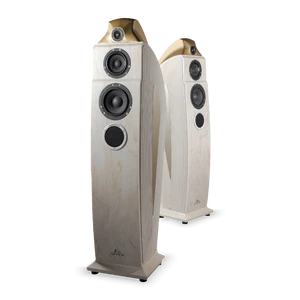
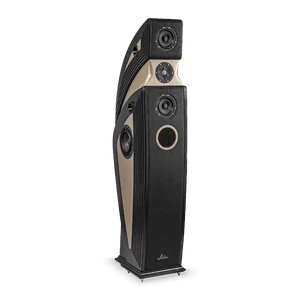
Sphinx builds sculptural speakers in which every curve has an acoustic purpose: a harp-like silhouette, a stone-like exterior that damps resonance and a raised tweeter housing shaped for wide, stable imaging. Two floorstanding models make up the Element Series, the Element 3 and the larger Element 5, each hand-built in the Netherlands within the Siltech Group. Both present a gentle load to the amplifier, and Audio Lounge arranges demonstrations in Wigmore Street on enquiry.


Sculpture With an Acoustic Brief
The first impression of a Sphinx loudspeaker is sculptural; the second is that the sculpture works for the sound. Sphinx sums up the Element Series in three words, form follows function, and the harp-like outline and the dense, stone-like composite skin both serve the music: the heavy exterior damps resonance, keeping the cabinet silent as the orchestra swells. Above the main body, the tweeter sits in a raised housing sculpted for dispersion, which lets the stereo image open out well beyond the cabinets. The design of the Element 3 earned a 2025 European Product Design Award.
Bass Without Strain
Every cone that moves forward also sends sound backwards, and a conventional cabinet works hard to trap that rear wave and soak up the energy. Sphinx takes the opposite course with Zero Gravity Bass: the energy behind the cone is held back by a precise delay and returned in step with the front wave, adding weight and scale rather than blur. The principle belongs to the transmission-line family. The Element 3 uses a modified transmission-line bass section, while the Element 5 builds a dual-channel line around a pair of woofers set back to back, so the opposing forces cancel and the cabinet stays composed at full scale. For anyone comparing transmission-line speakers, the Element 5 is the most complete expression of the idea in the range.
A Gracious Partner for Valve Amplifiers
Both models are built around a power-assisted crossover, and the result is a loudspeaker that asks remarkably little of the amplifier. The amplifier sees a conventional passive load of high impedance, while inside the cabinet the crossover works at line level, using no inductors at all, and a dedicated power module feeds each driver. Sphinx compares the arrangement with power steering: the amplifier keeps full authority over the sound, and the modules supply the effort. The Element 3 in particular opens the door to valve designs of modest output, which makes both models natural valve amp speakers. Solid-state power amplifiers and integrated amplifiers are equally welcome.
A Siltech Lineage
The Sphinx name first appeared in the 1980s on high-end electronics that Siltech built to designs by Edwin van der Kley-Rynveld, and across two decades those components earned admirers in Europe and Asia. The name now returns on loudspeakers shaped by the team behind the Siltech Symphony, the Siltech SAGA amplifiers and Crystal Cable’s Minissimo Forte. Internal wiring uses the group’s own Silver-Gold conductors, and each loudspeaker is assembled, tested and acoustically tuned by hand in the Netherlands, while the wider family continues in the Siltech and Crystal Cable collections. The full choice of floorstanding speakers sits one click away.
Questions About Sphinx
How do the two Sphinx speakers compare?
The Sphinx Element 3 suits most listening rooms, while the Sphinx Element 5 brings greater scale to larger spaces. The Element 3 stands 1,082.6 mm tall, weighs 56.4 kg per cabinet and is rated at 98 dB. The Element 5 rises to 1,356 mm and 66.2 kg, places a beryllium tweeter between two midrange units and is rated at 95 dB. Both are three-way designs with Zero Gravity Bass.
Are Sphinx loudspeakers suited to valve amplifiers?
Yes. Both are easy to drive, each presenting a nominal 16 ohm load. For the Element 3, Sphinx asks for a valve amplifier of 20 watts per channel or more into 16 ohms, and for the Element 5, 60 watts or more; solid-state and digital designs should deliver 50 and 150 watts per channel into 8 ohms respectively. A demonstration with the intended amplifier remains the surest guide.
Do Sphinx loudspeakers need mains power?
Yes. Each cabinet draws mains power for the built-in amplification, while the amplifier connects in the usual way through one set of speaker terminals. Behind those terminals, the power-assisted crossover divides the signal before any power is added, and every speaker unit is driven by a separate Class D module, so the amplifier sees only a simple passive load. A power switch sits on the rear panel.
Who makes Sphinx?
Sphinx Audio belongs to the Siltech Group in the Netherlands, home to Siltech and Crystal Cable and led by Edwin van der Kley-Rynveld. The name first graced Siltech-built electronics in the 1980s, and today the Element Series carries the same engineering thinking into loudspeakers, from cabinet to crossover to internal wiring.
Where can Sphinx loudspeakers be heard in London?
At Audio Lounge on Wigmore Street, by appointment. Ask the team to set up the Sphinx Element 3 or Element 5 for a private audition; the team can also advise on room placement and partnering electronics, and can include an amplifier you already own.