Speaker Cables
Speaker cables carry the full output of the amplifier to the loudspeakers, and the conductor, the insulation and the geometry of that short run all shape what reaches the room. This collection brings together hi-fi speaker cables from two Dutch sister brands, Siltech and Crystal Cable, and from The Chord Company of Amesbury, from monocrystal copper to monocrystal silver. For lengths, terminations and advice on matching a cable to a system, ask Audio Lounge.
 Price range: £33.00 through £204.00Select options This product has multiple variants. The options may be chosen on the product page
-
Price range: £260.00 through £2,660.00Select options This product has multiple variants. The options may be chosen on the product page
-
Price range: £620.00 through £1,340.00Select options This product has multiple variants. The options may be chosen on the product page
-
Price range: £1,360.00 through £1,750.00Select options This product has multiple variants. The options may be chosen on the product page
-
Price range: £1,610.00 through £2,120.00Select options This product has multiple variants. The options may be chosen on the product page
-
Price range: £2,390.00 through £3,640.00Select options This product has multiple variants. The options may be chosen on the product page
-
Price range: £2,410.00 through £3,090.00Select options This product has multiple variants. The options may be chosen on the product page
-
Price range: £3,580.00 through £35,190.00Select options This product has multiple variants. The options may be chosen on the product page
-
Price range: £4,030.00 through £6,260.00Select options This product has multiple variants. The options may be chosen on the product page
-
Price range: £6,980.00 through £7,970.00Select options This product has multiple variants. The options may be chosen on the product page
-
Price range: £7,040.00 through £10,620.00Select options This product has multiple variants. The options may be chosen on the product page
-
Price range: £9,840.00 through £97,500.00Select options This product has multiple variants. The options may be chosen on the product page
-
Price range: £11,930.00 through £95,420.00Select options This product has multiple variants. The options may be chosen on the product page



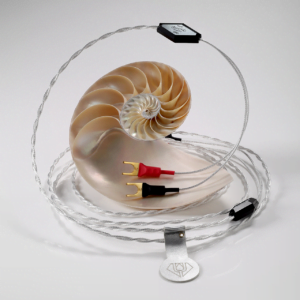


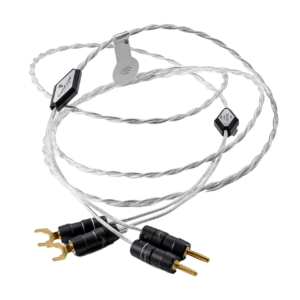


What a Speaker Cable Has to Do
A speaker cable carries far more current than a line-level interconnect and has to deliver everything the amplifier sends to the drive units while adding as little as possible along the way. Resistance, inductance and capacitance all play a part, and so do the insulation around each conductor and the way a pair is twisted or arranged. The plain speaker wires supplied with many systems, or hi-fi speaker wire bought by the metre, can serve a simple set-up. High-end speaker cables treat the run as a component of the system, and every audiophile speaker cable in this collection is engineered around the metal and the insulation of each conductor.
Choosing the Best Speaker Cable
There is no single best speaker wire for every system, and a high-quality speaker cable still has to fit the installation, so the choice begins with length and terminals. The Chord Company advises a cable no longer than the installation needs, measured with a piece of string before ordering, and supplies most pairs at equal lengths. Banana plugs and spades both suit the terminals of most amplifiers and loudspeakers; The Chord Company prefers the firm contact of a banana plug and suggests checking spades for tightness from time to time. The conductor comes next. Copper, silver-plated copper, silver-gold alloy and monocrystal silver are all represented here, and the best speaker cables are those chosen to suit amplifier, loudspeakers and room as a whole, judged by listening in the system itself.
Siltech, from Monocrystal Copper to Silver
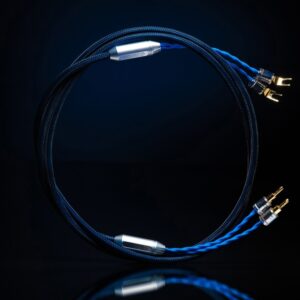
Siltech, founded in 1983 and still run as a family business, designs and makes every cable in the company’s own factory in Elst, the Netherlands. The Explorer 180L opens the range with monocrystal copper. The Classic Legend MkII series moves to G9, Siltech’s silver with carefully controlled traces of gold, from the new 280L through the 380L, 680L and 880L, each cable handcrafted in the Netherlands. Above sit the Royal Crown cables: the Royal Single Crown, with S10 monocrystal silver in a six-core hexagon, and the Royal Triple Crown, with two cores of monocrystal silver in a multicell construction. At the summit stands the Master Crown, the flagship Siltech silver speaker cable.
Crystal Cable and The Chord Company
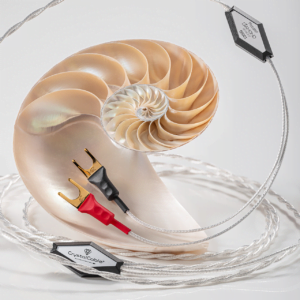
Crystal Cable, the Siltech sister brand in Elst, builds the Diamond speaker cables around a silver-gold alloy, stepping up from the Piccolo Diamond through the Micro Diamond to the Ultra Diamond. The Chord Company has designed and hand-built cables in Amesbury, Wiltshire, since 1985, and the RumourX twists a pair of silver-plated copper conductors inside XLPE insulation, a cable The Chord Company describes as an all-rounder of discreet proportions. The audiophile speaker cables here come in several lengths and terminations to suit.
Partnering Speaker Cables
A speaker cable is usually chosen once the loudspeakers and the hi-fi amplifier are settled, so the cable can be matched to both. All three brands also make digital audio cables and hi-fi power cables, so one family of conductors can run through the whole system, and the wider collection of hi-fi cables gathers every type in one place. The full ranges sit in the Siltech and Crystal Cable collections and in the collection of The Chord Company, and Audio Lounge welcomes questions about hearing two cables in one system.
Questions About Speaker Cables
What is the best speaker cable UK buyers can choose?
The best speaker cable depends on the system, from amplifier and loudspeakers to the length of the run, so the answer changes from one room to the next. Here, the Siltech Classic Legend MkII cables bring silver-gold conductors to a wide range of systems, the monocrystal silver of the Royal Crown cables and the Master Crown leads the range, and the RumourX from The Chord Company keeps silver-plated copper in a slim twisted pair. Ask Audio Lounge about comparing two.
Do speaker cables make a difference?
The manufacturers here say yes and design on that basis. The speaker cable guide from The Chord Company describes changes in dynamics, detail, tonality and timing when cables are compared, and Siltech sets conductor, insulation and shielding to hold back distortion and interference. How much a change matters depends on the system, so the surest test is to hear two cables in the same room. Audio Lounge can suggest which two to try.
Is silver speaker cable better than copper?
Silver conducts electricity slightly better than copper, which is why Siltech builds the Royal Crown and Master Crown cables on monocrystal silver and the Classic Legend MkII on a silver-gold alloy. Copper keeps a place: the Explorer 180L uses monocrystal copper, and The Chord Company plates copper with silver in the RumourX, arguing that the reputation of silver for brightness is undeserved when the insulation is right. Hearing both decides.
How long should speaker cables be?
Only as long as the installation needs: The Chord Company suggests running a length of string along the route first. Matching left and right lengths is usual, and some amplifiers require matched pairs, though others accept a difference. Here, the Classic Legend MkII cables start at one metre and the Royal Single Crown, Royal Triple Crown and Master Crown at two metres, with extra half-metre lengths on the larger Siltech cables.
What are speaker cable jumpers for?
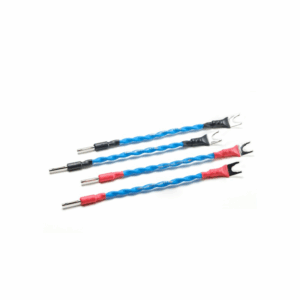
Jumpers link the two pairs of terminals on a loudspeaker built for bi-wiring when a single pair of cables is used, replacing the plated links supplied as standard. Siltech makes Classic Legend jumpers to match the 380L, 680L and 880L, with spade or banana ends, and The Chord Company reports a surprising improvement, particularly in the treble, once the standard links are replaced.