The Ruark R710 and the Return of the Disc
Somewhere between the streaming queue and the record shelf sits a stack of compact discs that most modern systems have quietly abandoned. The Ruark R710 brings those discs back into daily life. Ruark calls the R710 a CD hi-fi console, and the description fits: a slot-loading disc player, a network streamer, a phono stage and a powerful amplifier share one low, seventies-inspired cabinet, ready to drive a pair of passive loudspeakers.
The idea is simple to state and rare to find. Most streaming amplifiers ask for a separate transport, and most disc players need an amplifier beside them; the R710 treats every source as an equal. A disc slides into the slot, the colour display answers, and the music begins. Spotify, a turntable and the television follow the same short path to the loudspeakers, so a collection built over decades feels whole again.
A Mechanism Hidden in Walnut
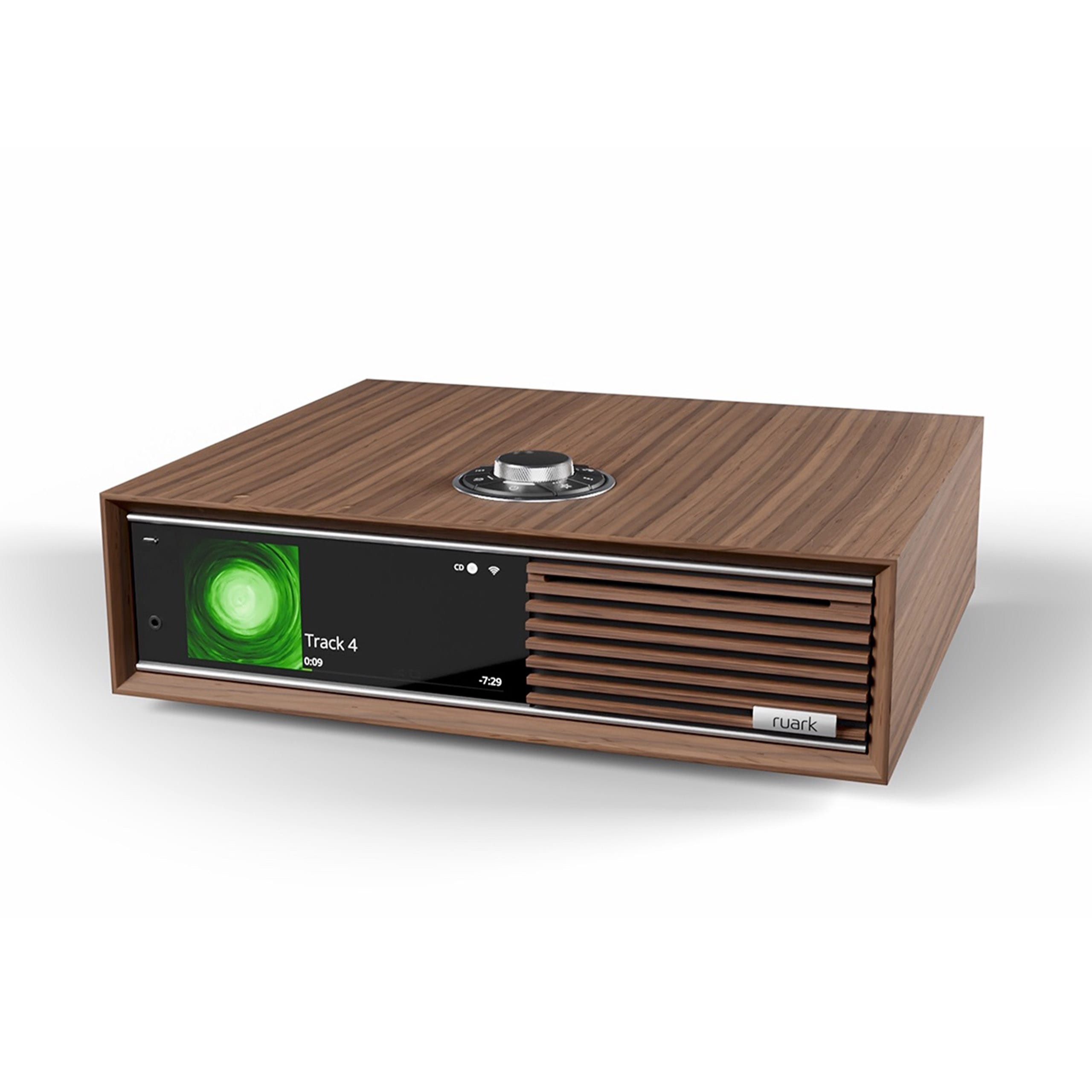
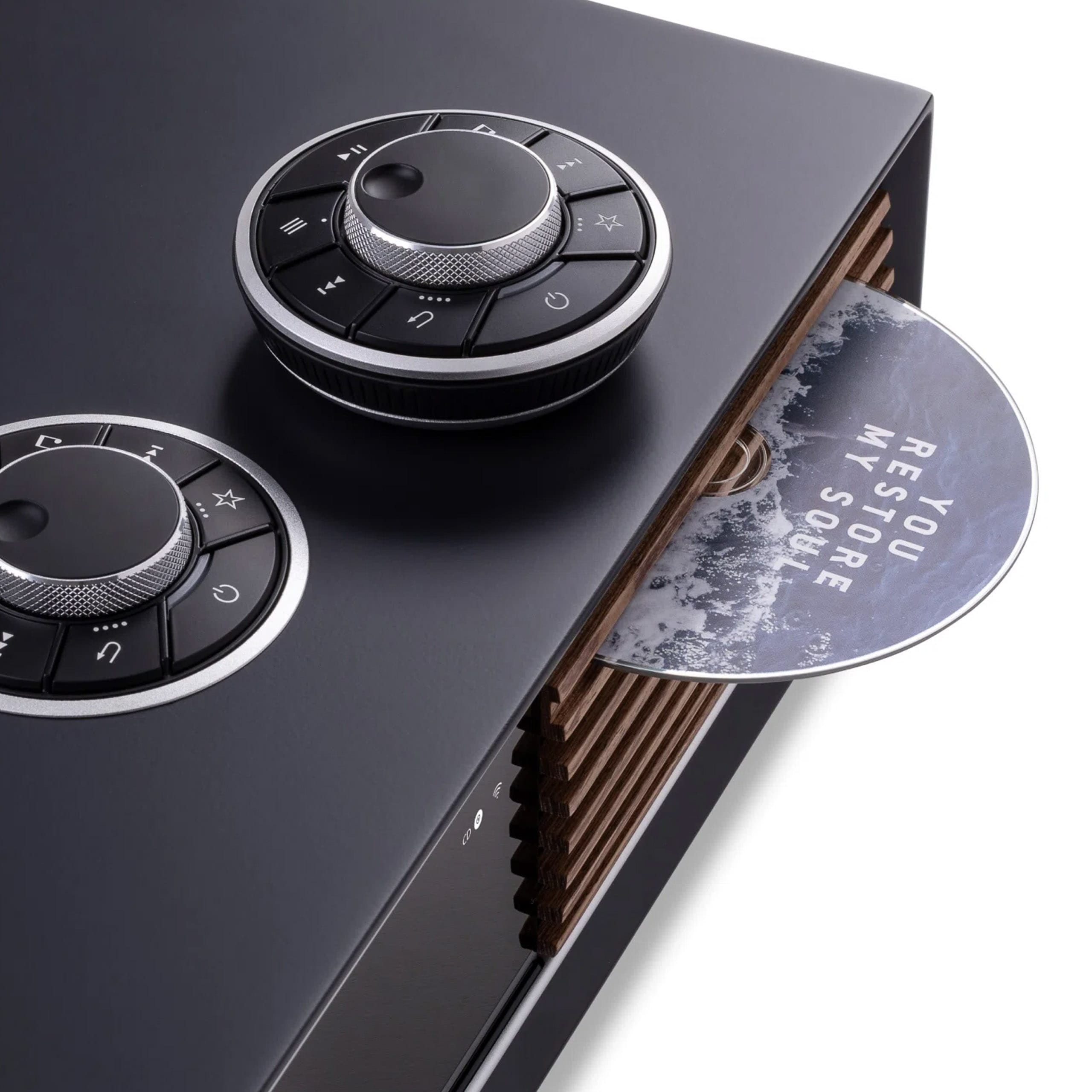
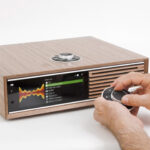
Ruark has always treated cabinetwork as part of the sound, and the R710 carries that inheritance naturally. A facia of walnut slats runs across the front, and the CD mechanism sits concealed within them, the slot almost invisible until a disc approaches. Two finishes are offered: Fused Walnut veneer throughout, or a Satin Charcoal lacquered cabinet framed by the same walnut slats.
The proportions are domestic rather than industrial. Low enough to sit beneath a television or along a sideboard, the R710 reads as furniture first and electronics second, and replacing a separate disc player, streamer and amplifier with one console leaves a room noticeably calmer.
Power Without Strain
Behind the slats, a switch-mode power supply feeds the electronics and Ruark’s custom amplifiers, and the circuit boards are laid out for short signal paths and careful grounding. Class D amplification delivers 200 watts per channel, enough authority for demanding floorstanding loudspeakers, yet the lasting impression is ease: bass arrives with weight and grip, and loud passages stay composed rather than hardened.
Digital sources pass through a Burr-Brown converter, the part that turns every disc and every stream into the signal the amplifier receives. Cooling fans switch on automatically only when needed, keeping the interior as composed as the sound. With the adaptive loudness setting engaged, late-evening listening at low volume keeps a fullness that quiet playback usually loses.
A Library Beyond the Shelf
When the disc comes out, a vast catalogue takes over. Three services live inside the R710: Spotify Connect, Qobuz Connect and TIDAL Connect. Music flows straight from the service while the phone stays free for calls or can be switched off altogether. Apple AirPlay and Google Cast carry almost every other app, from Apple Music to BBC Sounds, and internet radio brings stations from around the world with no aerial to install.
A quad-core processor handles high-resolution files from a network library or a USB drive, and the Ruark R710 streaming amplifier can be grouped with further AirPlay and Google Cast devices whenever music is wanted in several rooms. Roon users will find the R710 listed as a Google Cast endpoint. In effect, the console is a Wi-Fi CD player, a streamer and an amplifier at once, and each part hands over to the next without ceremony.
Records, Films and Late Evenings
Vinyl has a direct way in. The turntable input leads to a moving magnet phono stage, so a deck can be connected without a separate preamplifier, and the gain can be set from the menu to suit the cartridge. Should a hum appear, a ground terminal on the back panel accepts the turntable’s earth wire.
The television is welcomed just as readily. HDMI eARC carries film and broadcast sound from the set over a single cable, after which the television remote looks after the volume. For private listening, a headphone socket serves wired headphones, Bluetooth headphones can be paired for sofa-side evenings, and the loudspeakers fall quiet whenever headphones take over.
The Pleasure of the RotoDial
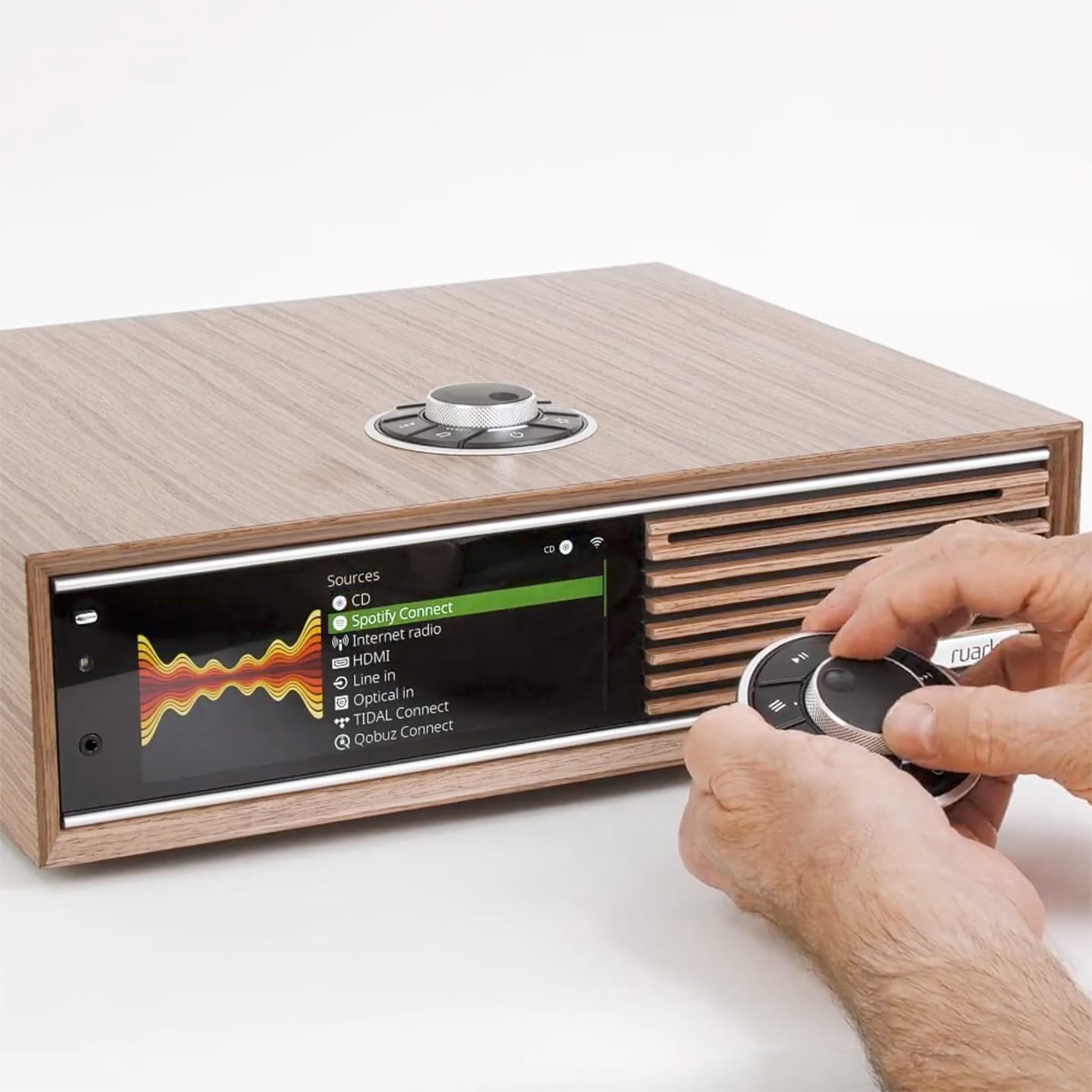
Daily use is shaped by touch. The RotoDial controller has been a Ruark signature since 2006, and the version redeveloped for Ruark’s 100 Series makes every adjustment a small pleasure. A large colour display presents menus, stations and album artwork, dimming automatically as the room darkens, and a matching rechargeable remote works over Bluetooth, so there is never a need to aim. Presets keep favourite stations close at hand, and alarms can wake the morning with a chosen station or a gentle tone.
A Partner for Passive Loudspeakers
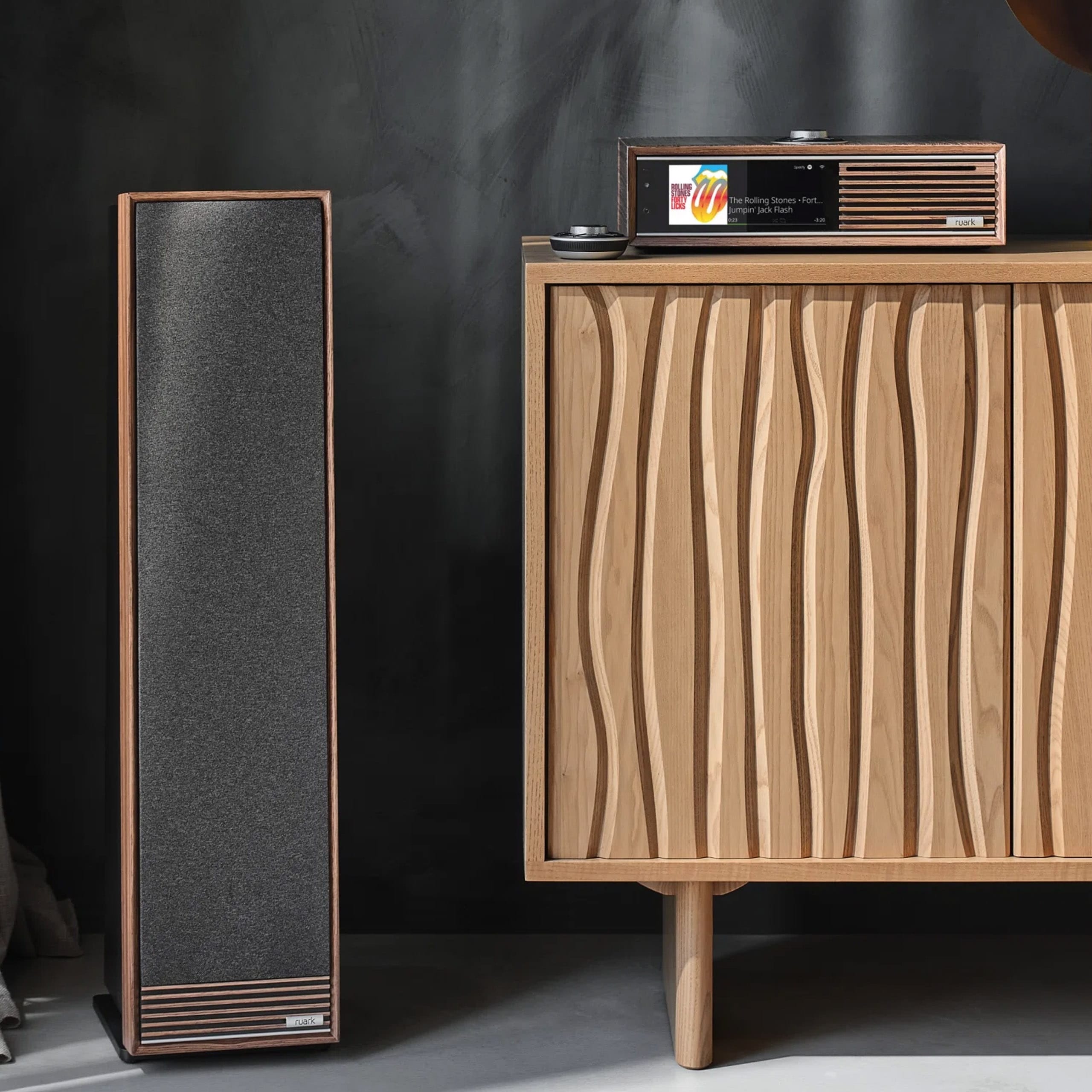
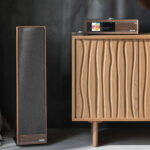
Loudspeakers are the one element the R710 leaves to choice. Ruark pairs the console with the Sabre-R bookshelf speakers or the new Talisman-R floorstanders, a revival of the 1990 Talisman that many enthusiasts credit with defining Ruark, and either pairing yields a system matched in design and sound. The amplifier is equally at home with other well-made passive speakers, and oxygen-free copper speaker cables come in the box.
Placement is flexible too. With the speakers set well apart, the stereo image opens naturally; on a sideboard or shelf, where the pair must stand closer together, Ruark’s Stereo+ setting widens the soundstage. A dedicated subwoofer output adds depth in larger rooms, and a switchable pre-out leaves room for a separate power amplifier later.
A Demonstration in Marylebone
The truest test of any system is familiar music. Audio Lounge on Wigmore Street can arrange a demonstration of the R710 with the Sabre-R or with loudspeakers from the wider collection, playing a disc brought from home alongside a favourite stream. Ruark backs every console with a guarantee that lengthens when the owner registers the system, and the Audio Lounge team can advise on the pairing that suits the room.
About Ruark
Ruark is a family-owned British audio company on the Essex coast, founded in 1985 by Alan O’Rourke and his father Brian, a trained cabinet-maker who had worked alongside pioneers of British hi-fi. That grounding in timber and construction still guides every design, with real wood veneers, polymers, alloys and fabrics chosen as much for sound as for looks. Even after computer modelling arrived in the early 1990s, Ruark kept the final judgement for the ear, signing off every design by listening. Based in Southend-on-Sea since 1996, Ruark marks 2026 as forty years since the first Ruark loudspeakers appeared, with a range that now runs from table radios to consoles such as the R710. Explore the Ruark range at Audio Lounge.
Questions About the Ruark R710
What is the Ruark R710?
The Ruark R710 is a CD hi-fi console made by Ruark, the family-owned British audio company in Southend-on-Sea. A single cabinet combines a slot-loading CD player, a network streamer, a moving magnet phono stage, HDMI eARC and a Class D amplifier producing 200 watts per channel into 4 ohms. Loudspeakers are not built in, so a pair of passive speakers completes the system. Fused Walnut and Satin Charcoal finishes are available, both with walnut slats.
How does the Ruark R710 differ from the Ruark R610?
The Ruark R710 adds an integrated CD player and far more power than the Ruark R610: 200 watts per channel against 75 watts nominal, with a larger 6.8-inch display in place of a 5-inch screen. The R610 keeps DAB and FM radio but plays discs only through the optional Ruark R-CD100, a matching CD drive that connects by USB, whereas the R710 relies on internet radio.
Is the Ruark R710 a CD player with amplifier built in?
Yes. The Ruark R710 joins a slot-loading CD player to a 200-watt-per-channel amplifier, a network streamer and a phono stage, which makes the console a network CD receiver in hi-fi terms: a streaming amplifier with CD player, turntable input and headphone output under one lid. The drive plays Red Book audio CDs and CD-R discs, and a Burr-Brown 32-bit/192kHz DAC handles conversion. Passive loudspeakers are the only addition required.
Which loudspeakers suit the Ruark R710?
Passive loudspeakers rated between 4 and 8 ohms suit the Ruark R710, the range Ruark recommends for best results. As a CD player amplifier, the R710 delivers 200 watts per channel into 4 ohms at 0.01% THD through gold-plated 4mm binding posts. Ruark matches the console with the Ruark Sabre-R bookshelf speakers or the Talisman-R floorstanders, and two 3m oxygen-free copper speaker cables are supplied.
Which streaming services does the Ruark R710 support?
Spotify Connect, with Spotify’s lossless quality, sits alongside Qobuz Connect and TIDAL Connect inside the Ruark R710, making the console a CD player with Spotify, TIDAL and Qobuz on hand. Apple AirPlay and Google Cast bring in Apple Music, Amazon Music, Deezer, BBC Sounds and most other apps. High-resolution files as fine as 32-bit/192kHz play from UPnP media servers or USB-C storage, and Roon reaches the R710 through Google Cast, although the system is not Roon Certified.
Does the Ruark R710 include DAB or FM radio?
The Ruark R710 plays radio over the internet only, because Ruark left DAB and FM tuners out of this streaming-first design. Many internet stations now broadcast in CD quality, the choice is far wider, and no aerial is needed. Twenty presets hold favourite stations, with the first four recalled directly from the controls, and BBC stations can also be streamed through the BBC Sounds app over AirPlay or Google Cast.
Will a turntable work with the Ruark R710?
Yes. Any record deck with a moving magnet cartridge connects directly to the phono input of the Ruark R710, where a built-in RIAA stage rated at 47kΩ and up to 8mV removes the need for a separate preamplifier. Five gain settings, from -6dB to +6dB, suit cartridges delivering 2 to 8mV. Moving coil designs are not supported, decks with an integrated preamplifier belong on the line input, and a rear ground terminal helps cure hum.
Can the Ruark R710 play television sound?
Yes. One HDMI cable from the television’s ARC or eARC socket to the Ruark R710 carries programme sound, and the television remote then governs volume and power. The R710 accepts PCM only over HDMI, so choose PCM or stereo in the television’s audio menu rather than bitstream. An optical input, rated to 24-bit/96kHz PCM, serves sets that lack ARC, and Bluetooth headphones may introduce a slight lip-sync delay.
Does the Ruark R710 work with headphones?
Yes. The Ruark R710 offers a 3.5mm headphone socket and pairs with up to six Bluetooth headphones or speakers, with headphone volume set independently. Whenever headphones connect, the loudspeakers mute, and a Bluetooth pair takes priority over a wired one. Because any source can travel over Bluetooth, the R710 also works as a wireless CD player, sending a disc to headphones across the room. Phones and tablets stream in over Bluetooth with aptX HD.
How large is the Ruark R710, and what comes in the box?
The Ruark R710 cabinet measures 105mm high, 375mm wide and 310mm deep, or 125mm high and 345mm deep including feet, controls and cables, and weighs 6.6kg. Allow at least 10cm of clear space around the console for ventilation. The box contains the R710, a 2m mains cable, the rechargeable remote with a USB-C charging cable, two 3m oxygen-free copper speaker cables and a Quick Start Guide.