


Power and Scale, Told Truthfully
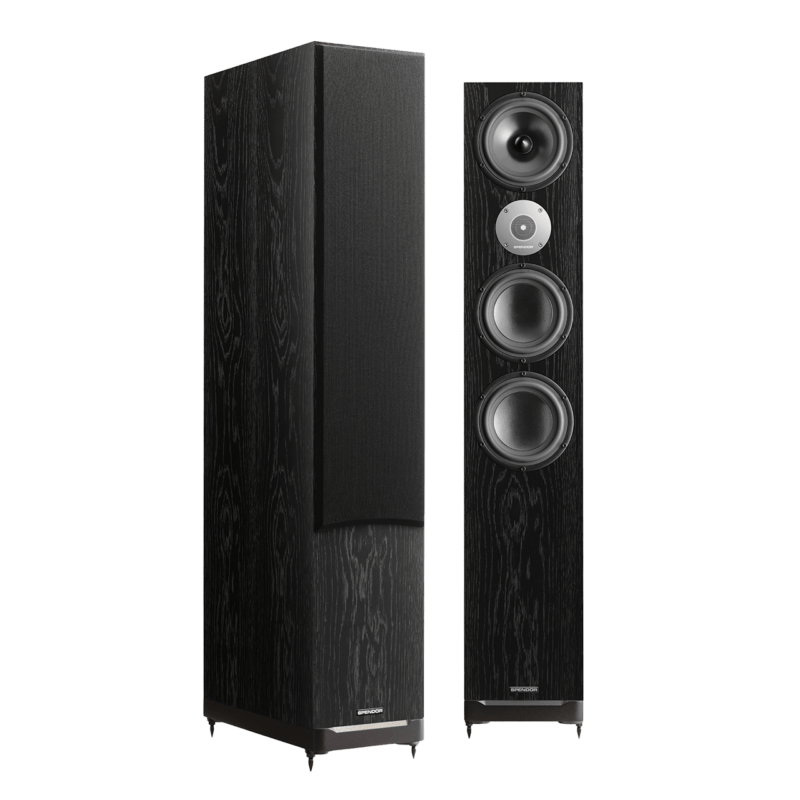
The Spendor D9.2 is the full three-way floorstander of Spendor’s D-Line: the largest of the four models, and the only one in which bass, midrange and treble each have a dedicated drive unit. Spendor set out to present music with real power and scale, and in a room the effect is size without exaggeration. An orchestra spreads wide and deep, a church organ lays down pedal notes with ease, and a quiet piano phrase keeps the air around every note.
Transparency is the other half of the promise. Spendor speaks of a superbly natural sound and an extraordinary resolution that draw the ear into the soundscape, and long acquaintance bears that out: familiar albums give up a breath before a phrase, the scrape of a bow, the last moment of a cymbal fading across the stage. Every one of Spendor’s five finishes is available from Audio Lounge, where the Spendor D9.2 can be auditioned by appointment.
A Midrange Driver Devoted to Voices
Three-way design is the defining decision. The midrange belongs to a dedicated 18cm EP77 polymer cone, spared the labour of deep bass, so voices, strings and brass occupy a band where the cone can stay composed. Spendor developed the EP77 cone with custom surround and suspension materials for thermal and mechanical stability, and credits the resulting drive units with exceptional dynamic ability and very good linearity at low levels.
The reward is heard most clearly in the human voice. A singer gains presence without edge, the grain of a cello stays intact, and soft passages keep the clarity of loud ones, which suits a late evening as much as a full-scale performance.
Two Kevlar Cones for the Foundation
Beneath the midrange, a pair of 18cm Kevlar composite cones takes charge of the low frequencies. Spendor’s own description credits the three cones and the tweeter, working together, with a sound that fills the room: pure vocals, fast and clean bass, precision and excellent dynamic expression.
Kick drums arrive with snap rather than boom, and a walking bass line holds both pitch and momentum as the volume climbs, so the scale of the Spendor D9.2 never turns heavy or slow.

They were detailed, dynamic, subtle, pacey and free from obvious nasties.
The LPZ Tweeter, Calm at Every Level
High frequencies belong to the LPZ, a polyamide dome tweeter that Spendor reserves for the D-Line. Spendor shapes the unit so that sound waves travel equal distances from the diaphragm and the dome works within a symmetrical field of pressure, which keeps the motion balanced and linear. Spendor’s stated aim is a clean and precise signal that highlights fine detail, lyrics above all, while staying natural enough for hours of music without fatigue.
An Aerofoil Inside the Bass Port
Low frequencies exit through the fifth generation of Spendor’s linear-flow port, a design that owes a debt to the diffusers of Formula One cars. Inside the opening sits a divider shaped in profile like an aircraft wing, which turns the vent into twin venturi passages; the air decelerates gently near the ends, then once more within a broad, tapering chamber at the foot of the cabinet. Even pressure along the whole port suppresses chuffing and stray radiation in the midrange, so the low end comes through deep and well defined, with natural timing, even where a pair must sit close to a wall in a modest room.
A Silent Cabinet on Steel Discs
Spendor positions the internal braces of the D9.2 enclosure asymmetrically, a layout that sharply reduces cabinet colouration. Dynamic Damping then places small, low-mass constrained polymer dampers wherever vibrational energy collects, turning that energy into inaudible heat instead of letting the panels release the energy slowly and blur the music.
At floor level, every D9.2 rests on four stabiliser discs machined from steel and fixed straight into the main structure, so the satin black plinth and the adjustable spike feet stay rigid. With no micro-movement beneath the cabinet, ambience and fine detail survive intact, and the stereo picture keeps a firm outline.
Crossovers on Gold-Plated Boards
Three drivers become one voice only through a well-judged crossover. For this model Spendor mounts the networks on custom-made, dual-layer, gold-plated circuit boards, then calibrates and matches every network, so the drive units integrate closely and the tonal balance runs evenly from the deepest bass to the top of the treble.
Spendor’s phase-linear approach shapes the parts list. Precision-wound tapped inductors allow frequency and phase to be tuned very finely, capacitors of audio grade are selected for linearity, and the internal wiring uses pure copper plated with silver, insulated by a dielectric free of halogens. Crossovers and drive units alike are calibrated, then paired against stringent broadcast reference standards, which helps a central voice stay locked between the two towers.
From the FL9 to the Spendor D9.2
Spendor’s history chart follows the D9.2 back through one unbroken line of large floorstanders: the FL9 of 1998, the S9 and S9e, the A9 of 2010 and the original Spendor D9, which joined the D-Line in 2016. The D9.2 took over from the D9 in 2019, and Spendor’s data sheet credits the near-silent cabinet with Dynamic Damping, working with the fifth-generation linear-flow port, for marked improvements in bass articulation and midrange dynamics.
Two decades of refinement show in the balance. The scale is that of a large tower, while the manners remain unmistakably Spendor: natural, unforced and faithful to the recording.
Five Finishes and the Wider D-Line
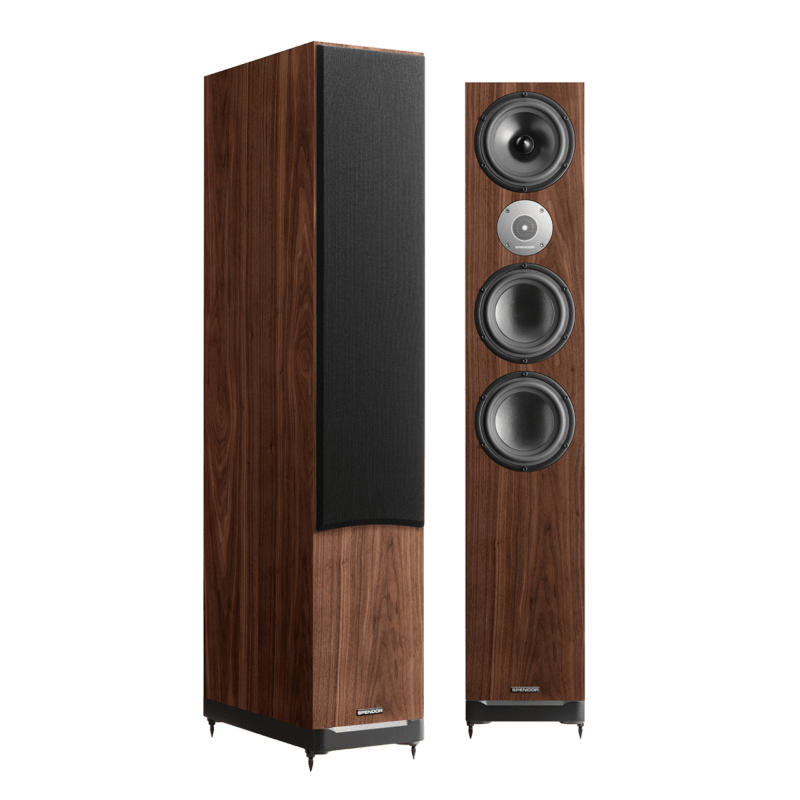
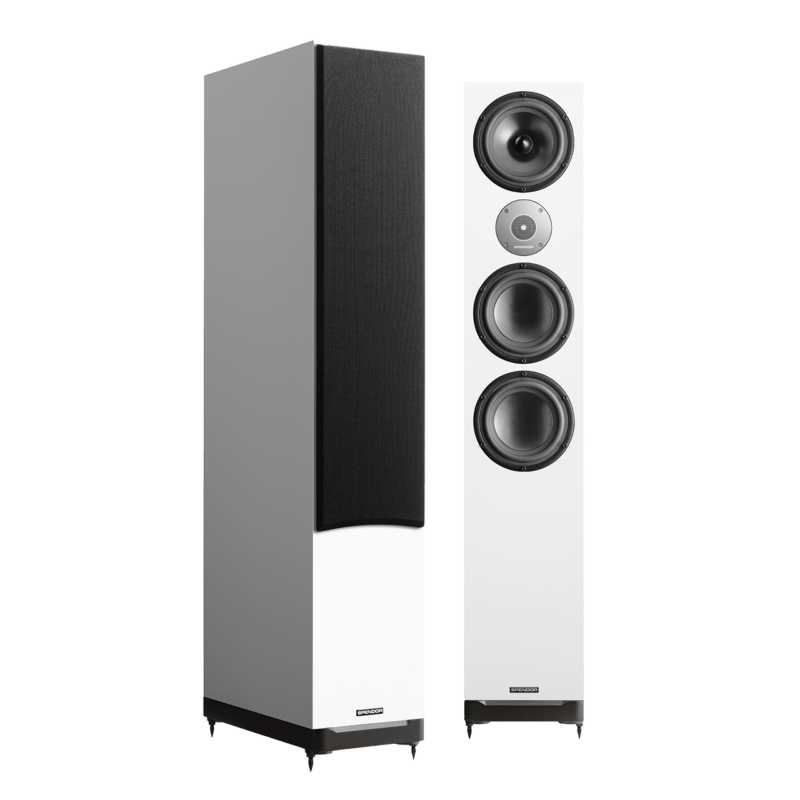
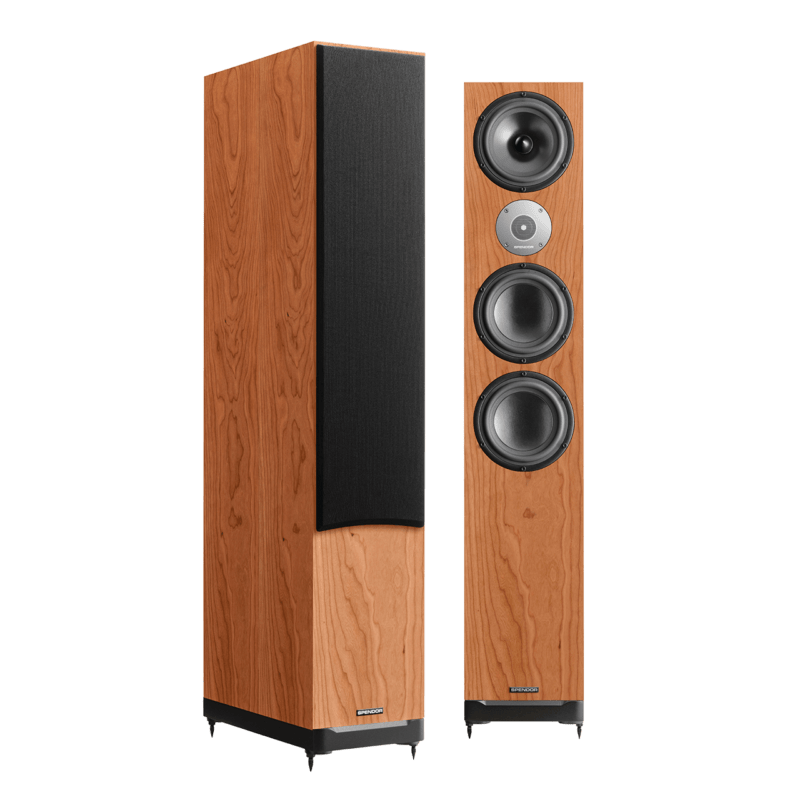
Black Oak, Oak, Walnut and Cherry come as real-wood veneers, with Satin White as the fifth choice, and every cabinet rests on a plinth finished in satin black. Spike feet of adjustable height arrive with each tower, together with a magnetic grille. Spendor treats colours shown online as a visual guide, so the veneers are best compared side by side in Wigmore Street. A single Cherry pair offered as ex-demonstration stock is listed separately.
The more compact Spendor D7.2 follows a 2.5-way plan in a slimmer cabinet, and the Spendor DC1, a centre-channel model, was conceived as a partner for both D-Line towers when music and film run across several channels. For a wider view, the floorstanding speakers of every make stocked by Audio Lounge sit together on one page.
About Spendor
Spendor began with a problem at the BBC, where Spencer Hughes worked as an engineer through the 1950s and 1960s. To cure the inconsistent playback of the monitors then in use, he built the BC1 at home, and the design was soon approved across the entire corporation. Spencer and Dorothy Hughes then established Spendor in the late 1960s, the name fusing Spen with Dor. Spendor remains privately owned, today under Philip Swift, a co-founder of Audiolab, and designs and engineers every loudspeaker in the UK; assembly takes place in South Yorkshire, and the cabinets are made at Spendor’s own facility in Sheffield. Each current Spendor model in stock appears in the Spendor collection, and demonstrations take place by appointment on Wigmore Street.
Questions About the Spendor D9.2
What is the Spendor D9.2?
The Spendor D9.2 is a three-way floorstanding loudspeaker and the largest model in Spendor’s D-Line, sold in pairs. Each cabinet holds Spendor’s LPZ tweeter, a 22mm polyamide dome, above an 18cm EP77 polymer midrange cone and two 18cm Kevlar composite bass cones, in an enclosure braced asymmetrically, treated with Dynamic Damping and vented through a fifth-generation linear-flow port. Designed and built by Spendor in Britain, the D9.2 replaced the original D9 in 2019.
What are the Spendor D9.2’s specifications?
Spendor’s data sheet credits the Spendor D9.2 with a typical in-room range of 27Hz to 25kHz and crossover points at 500Hz and 4.2kHz. Sensitivity reaches 90dB from a single watt at a metre, while a nominal impedance of 8 ohms dips to a 4.6-ohm minimum. Spendor suggests 25 to 250 watts of amplification and rates handling at 250 watts of unclipped programme. Cabinets stand 1155mm high, 210mm wide and 398mm deep, at 35kg.
How does the Spendor D9.2 differ from the original Spendor D9?
As the refined form of the same design. Spendor’s history chart dates the original Spendor D9 from 2016 and the Spendor D9.2 from 2019, when the earlier model ended. Spendor’s data sheet attributes marked gains in bass articulation and midrange dynamics to the near-silent cabinet with Dynamic Damping and to the fifth-generation linear-flow port, and Spendor’s range sheet marks the EP77 polymer cones and the Kevlar composite bass drivers as new.
Why does the Spendor D9.2 use a three-way design?
So that every part of the frequency range is handled by a dedicated drive unit. Two 18cm Kevlar composite cones work below 500Hz, an 18cm EP77 polymer cone covers the band from there to 4.2kHz, and the LPZ tweeter takes over above that point. With the low frequencies handled elsewhere, the midrange cone concentrates on voices and instruments, the region where Spendor’s description promises pure vocals and fine dynamic expression.
What amplifier suits the Spendor D9.2?
Any good amplifier delivering 25 to 250 watts, the range Spendor recommends. Sensitivity of 90dB, together with a load of 8 ohms nominal that dips no lower than 4.6 ohms, means the Spendor D9.2 asks little of a capable partner, and Spendor calls the D-Line floorstanders compatible with all good amplifiers. Pairings with models from the power amplifiers or integrated amplifiers collections can be demonstrated at Audio Lounge.
Where should the Spendor D9.2 be placed?
As a starting point, Spendor’s stereo set-up guide places the towers between two and three metres apart, at a similar distance from the main seat. Bringing the towers nearer the rear wall adds bass, while more space behind gives more convincing imaging. Angle both slightly towards the seat, avoid matching distances from the rear and side walls, which can excite standing waves, then level each cabinet on the spikes using a spirit level.
How does the Spendor D9.2 compare with the D7.2?
As the larger, three-way sibling. The Spendor D7.2 uses a 2.5-way layout, 980mm tall and 21.2kg, with one EP77 cone and one Kevlar bass unit, reaching down to 29Hz. The Spendor D9.2 adds a dedicated midrange and a second Kevlar bass unit in a 1155mm, 35kg cabinet, reaches 27Hz and accepts amplifiers of up to 250 watts. Both share the LPZ tweeter and the linear-flow port.
Which finishes does the Spendor D9.2 come in?
Five, and Audio Lounge offers all five: Black Oak, Oak, Walnut and Cherry real-wood veneers, plus Satin White, every finish sitting on Spendor’s satin black plinth. Spendor regards online colours as a visual guide, so the veneers are best judged in person at Wigmore Street. One Cherry pair formerly used for demonstration is also listed, as an ex-demonstration pair.
Has the Spendor D9.2 won awards?
Yes. HiFi Critic presented the Spendor D9.2 with an Audio Excellence award, following Chris Frankland’s review in the October to December 2019 issue. The quoted line on this page comes from that review and links to the full text. Spendor’s own D-Line literature describes the range as multi-award winning.
Can a demonstration of the Spendor D9.2 be arranged?
Yes, by appointment at the Audio Lounge showroom, Wigmore Street, London, where the Spendor D9.2 can be heard with amplification chosen to suit the music and the room. Reservations are made online and the pair is collected in person from the showroom, so a demonstration and the collection can share a single visit, with advice on placement and partnering equipment along the way.