
The Reference CD Player of the Radia Series
The ARCAM CD25 sits at the summit of ARCAM’s disc-playing line, and the design brief behind the ARCAM CD25 is unusually easy to state: split the conversion in two, keep the power supply linear, and give the analogue signal a balanced route out of the chassis. None of that is fashionable. Every part of that programme is difficult. What emerges is a reference CD player that treats a familiar album as new information rather than a settled question, and that gives a serious system somewhere honest to start.
Two Converters, One Purpose
Digital-to-analogue conversion is split down the middle. Each channel receives a dedicated ESS converter running in balanced mode, with a dedicated reference voltage regulator alongside — the first dual-mono arrangement ARCAM has put into a disc player since the FMJ D33, and the first ARCAM design of any kind to carry the fourth-generation ESS Hyperstream architecture. The audible consequence is separation. Left and right stop borrowing from one another, and the space between performers acquires edges instead of a general glow.
Silence as a Design Goal
Power arrives through a linear toroidal supply rather than a switching one, an old-fashioned choice that costs weight, space and money, and returns something no measurement quite captures: quiet. Fine detail does not have to climb out of a noise floor to be heard. Dynamic contrast opens rather than compresses. A held note decays into darkness rather than into hiss, and the ear stops working so hard.
A Chassis That Refuses to Ring
The disc mechanism is carried on an internal vibration-damping structure, isolated from the outer casework so that the laser assembly reads what is pressed into the disc rather than what the room is doing to the cabinet. Accurate retrieval is unglamorous engineering, and the reward is timing. Phrases begin and end where the musicians intended them to, and a rhythm section holds together at volume instead of smearing.
Balanced Out, and Single-Ended Too
Two sets of analogue outputs leave the rear panel. The balanced XLR pair carries the dual-mono signal path intact into a fully balanced amplifier, rejecting interference along the way and preserving the channel isolation the converter arrangement worked to create. A conventional RCA pair serves every other amplifier without apology. Optical and coaxial digital outputs sit alongside, so an external converter or a processor can take the raw data instead.
Radia, in the Metal
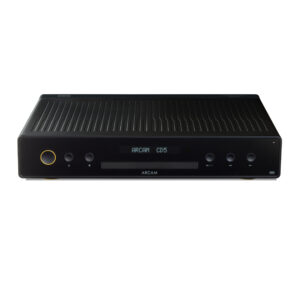
A glass front panel, a crisp OLED display and a machined metal chassis place the ARCAM CD25 unmistakably within the Radia design language, alongside the amplifiers the range was built around. At six and a half kilograms the ARCAM CD25 has the density of something engineered rather than assembled, and the drawer glides rather than clatters. Packaging is plastic-free, which matters more than the specification sheet lets on.
A Long Argument With Digital
The Delta 70 arrived in 1986, and ARCAM has been revising the answer ever since — through the Alpha years, through FMJ, and now into Radia. Voicing decisions on the ARCAM CD25 were settled by blind listening rather than by preference, with objective measurement setting the floor and the ear setting the ceiling. That method is why an audiophile CD player from this company tends to sound composed rather than impressive, and why the effect survives long sessions.
Where the ARCAM CD25 Belongs
As a separates CD player, the ARCAM CD25 answers a specific brief: a physical library that deserves better than a convenience source, and an amplifier good enough to show the difference. Among current CD player separates, few offer a balanced output at all, which makes system matching unusually straightforward at this level. The disc shelf becomes an argument for staying home.
About ARCAM
A&R Cambridge opened for business in 1976, shortened the name to ARCAM in the following decade, and has kept design and engineering in the same corner of Cambridgeshire ever since — now with the wider resources of HARMAN Luxury Audio behind the work. The company reached Compact Disc early and has treated digital replay as unfinished business through every generation since, each player built to answer a question the previous one left open. That habit of returning to the same problem with better tools is what the Radia Series inherits, and what the CD25 brings to a conclusion. Audio Lounge carries the ARCAM range in full, and the Wigmore Street rooms are set up for unhurried comparison.
Questions About the ARCAM CD25
What is the ARCAM CD25?
The ARCAM CD25 is the flagship Compact Disc player of ARCAM’s Radia Series, developed at the company’s Cambridgeshire engineering base. The ARCAM CD25 reads CD, CD-R and CD-RW through a dual-mono digital-to-analogue converter arrangement, a linear toroidal power supply and a vibration-damped disc mechanism, and offers balanced XLR alongside single-ended RCA analogue outputs.
What is a dual-mono DAC?
A dual-mono DAC gives each stereo channel a converter of its own rather than sharing one device between both. In the ARCAM CD25, two ESS ES9039Q2M converters each handle a single channel in balanced mode, each with an ESS reference voltage regulator. Separating the channels this way reduces crosstalk and lowers noise, which is heard as wider, more stable stereo imaging.
How does the ARCAM CD25 compare with the ARCAM CD5?
The ARCAM CD25 is the larger design in every respect that matters. Balanced XLR outputs, a dual-mono converter pair and a linear toroidal power supply are all exclusive to the ARCAM CD25. One capability moves the other way: the ARCAM CD5 plays files from a USB stick, which the ARCAM CD25 does not. Both handle the full Compact Disc family, recordable and rewritable discs included.
Is the ARCAM CD25 a balanced output CD player?
Yes. The ARCAM CD25 is a CD player with XLR output as well as RCA, and the balanced pair carries the dual-mono signal path through to the amplifier intact. Maximum analogue output is 4.4 V RMS balanced and 2.2 V RMS single-ended. Balanced connection suits longer cable runs and fully balanced amplifiers, where it also preserves the channel isolation the converter arrangement creates.
Which digital outputs does the ARCAM CD25 have?
Two. The ARCAM CD25 is a CD player with optical output and coaxial S/PDIF alongside, so a CD player with digital output can feed an external converter, an AV processor or a digital recorder directly from the transport. Signal-to-noise ratio on the digital outputs is quoted at 94 dB at 16-bit and 116 dB at 24-bit.
Which discs and file formats does the ARCAM CD25 play?
Compact Disc in audio and data form, recordable and rewritable alike. From data discs the ARCAM CD25 reads WAV (LPCM), FLAC, MP3 and AAC files at 16 to 24 bit. Sample rates run to 96 kHz for WAV and FLAC — 96, 88.2, 48, 44.1 and 32 kHz — and to 48 kHz for MP3 and AAC. There is no USB input on this model.
Which amplifiers pair with the ARCAM CD25?
Balanced XLR outputs make the ARCAM CD25 a natural partner for the fully balanced ARCAM A50 Signature and ARCAM SA45, while the RCA outputs suit the ARCAM SA35 and A25+. As a CD player for hifi system owners outside the Radia range, either output works with any conventional integrated or pre-amplifier.
How is the ARCAM CD25 powered?
Through a linear toroidal power supply rather than a switch-mode one. Linear regulation costs weight and internal space but delivers a quieter electrical foundation, which is why fine detail and low-level dynamics survive intact. Mains input covers 100–120 V and 220–240 V at 50/60 Hz, maximum consumption is 20 W and standby draw is under 0.5 W.
What makes the ARCAM CD25 an audiophile CD player?
Three decisions, taken together. Conversion is dual-mono rather than shared; power is linear and toroidal rather than switched; and the transport is isolated on a damped internal structure. Each addresses a different noise or timing problem, and ARCAM settled the voicing through blind listening tests rather than measurement alone. The result is composure at length rather than immediate impact.
Where does the ARCAM CD25 sit in the Radia Series?
At the top. The ARCAM CD25 is the reference CD player of the range, introduced alongside the A50 Signature amplifier in ARCAM’s fiftieth anniversary year, and the first ARCAM design since the FMJ D33 to use dual-mono conversion. The CD5 remains the entry point to Radia disc playback; the ARCAM CD25 is the destination.
How big is the ARCAM CD25, and what comes in the box?
Measurements are 431 mm wide, 329 mm deep and 84 mm high including feet, with a net weight of 6.5 kg and a shipping weight of 9.5 kg. Supplied alongside the player: a mains lead, a remote handset with a pair of AAA cells, the Quick Start Guide and safety documentation. Packaging is plastic-free. Allow ventilation clearance and an ambient temperature below 35°C.