

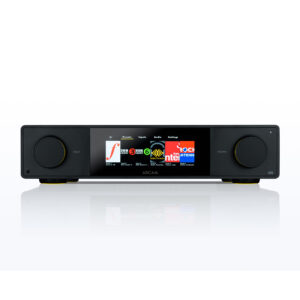
A flagship built for one room and one purpose
The ARCAM SA45 is the amplifier ARCAM builds when the brief is simply to make the best one. As the flagship of the Radia range, the ARCAM Radia SA45 takes the fully balanced architecture of the A49, the integrated amplifier ARCAM regards as the high point of the company’s amplifier design, and places around that heritage everything a modern music room asks for: high-resolution streaming, digital conversion of reference quality, phono stages for both cartridge types, television connection and room correction. The purpose is a single chassis that removes the reasons for owning separates without removing any of the performance.
The SA45 looks the part. A deep, heavy enclosure, dials that turn with damped precision, and a bonded high-resolution screen wide enough to read from the sofa give the amplifier a presence that photographs cannot quite convey. Designed in Cambridge, the SA45 is intended to remain the centre of a system for a very long time.
Class G, in ARCAM’s fifth generation
Amplification is the competence ARCAM was founded on, and Class G is the form the company has refined over successive generations. The principle is elegant: the amplifier runs in Class A for the opening watts, where music lives most of the time and where the sound is purest, and a second, higher-voltage supply steps in only when a crescendo calls for more. The SA45 represents the fifth generation of that thinking, with components and materials re-examined for this model and a new linear toroidal transformer supplying the whole of the audio circuitry. A separate switching supply exists only for standby, so nothing but the linear supply is at work while music plays.
The result is 180 watts per channel, and a character that belies the number. Quiet passages carry the intimacy of a small Class A amplifier; loud ones arrive with reserves that feel bottomless. Difficult loudspeakers, the kind that expose lesser amplifiers under load, are simply driven, and the sense of grip in the bass is one of the first things a listener notices.
Balanced by design, not by adaptor
Many amplifiers offer an XLR socket and convert the balanced signal to single-ended immediately behind the panel. The SA45 does something rarer at any price: the digital and analogue audio paths are balanced throughout. The new digital platform is built on a multi-layer board with a ground plane spanning the whole of the layout, isolating the audio circuitry from noise and interference. Conversion is by the newest Hyperstream iV DAC from ESS in a balanced arrangement, with jitter elimination ahead of the analogue stages, and the balanced signal then travels to the output stages intact.
For a listener seeking an XLR amplifier, or specifically an amplifier with XLR input for a balanced source, the SA45 offers a dedicated XLR pair alongside three single-ended analogue inputs and delivers balanced pre-amplifier outputs on the way out. Long cable runs to a power amplifier or active loudspeakers lose nothing, the noise floor sits lower, and the space between notes is quieter than an integrated amplifier is usually permitted to be.
Two subwoofers, one coherent low end
Few stereo amplifiers take bass management seriously, and fewer still provide for a pair of subwoofers. The SA45 is a stereo amplifier with subwoofer output twice over, with two subwoofer connections that allow subwoofers to be positioned where the room, rather than the furniture, dictates. Dirac Live Room Correction is included and extends to the subwoofers, so main loudspeakers and subwoofers are measured together and corrected as one system, in time and in level.
The measurement microphone and cable come in the box, and the Dirac Live software walks through the process on a computer: a handful of measurements around the listening seat, a target curve, and a filter exported to the amplifier. What the room used to add, a boom here and a dip there, disappears; what remains is the bass the loudspeakers were always capable of, in the very room where the listening happens.
The screen that changes how streaming feels
An 8.8-inch bonded display gives the SA45 an advantage that is hard to appreciate until lived with. Album artwork, track and artist names and format details are legible from across the room, so the phone can stay in a pocket and the amplifier itself becomes the interface. Presets for favourite stations and playlists are recalled from the front-panel dial, and the remote control carries transport keys so a streaming source is paused, skipped and resumed as easily as a disc.
The platform behind that screen was designed in-house. The SA45 is Roon Ready, streams natively from Qobuz Connect, from Tidal Connect and from Spotify Connect using each service’s own application, and accepts Apple AirPlay and Google Cast from almost any device. Through the ARCAM Radia app come internet radio, podcasts, music on a network drive and files on a USB stick, and high-resolution files play natively with gapless transitions. Software updates arrive over the network in standby, so the platform matures rather than dates.
Records, television, headphones
A flagship integrated amplifier is measured by how many boxes on the rack become redundant. Vinyl is handled by two dedicated phono inputs, one for moving magnet and one for moving coil cartridges, sharing an earth post between them, so that a turntable of any pedigree connects directly with no external stage. The HDMI eARC input allows a television to route sound into the SA45, with the television’s own remote controlling volume and the amplifier waking to the HDMI input automatically, so film and broadcast sound share the same amplification and the same Dirac Live correction as music.
Bluetooth works in both directions: from a phone into the amplifier, and out from the amplifier to wireless headphones for listening after everyone else has retired, with Auracast broadcasting able to reach several sets at once. A choice of four DAC filters lets the balance between transient precision and tonal ease be set to taste, a quiet luxury that most amplifiers at any price do not offer.
Quiet competence in daily use
The refinements continue in the details. The halo lighting around the dials dims to suit the hour, inputs can be renamed and unused ones hidden so the carousel shows only what matters, and the display can be switched off entirely for a late listening session. A Pre Amp Mode turns off the internal power amplifier and turns the SA45 into a balanced streaming pre-amplifier for owners who wish to add a dedicated power amplifier later, which makes the flagship as much a foundation as a destination. Installers will find RS232 and network control and an infra-red input for integration into a wider system.
The ARCAM SA45 streaming amplifier rewards an unhurried audition. Audio Lounge keeps the flagship on demonstration at Wigmore Street and welcomes enquiries about hearing the SA45 with your own loudspeakers, or with a pairing from the showroom chosen to show what the amplifier can do.
About ARCAM
The ARCAM name comes from Amplification and Recording, Cambridge, the company two university engineers established in 1976 to build the A60, an integrated amplifier whose success carried a small workshop into one of the most respected names in British audio. The letter A in ARCAM stands for amplification, and the company has treated that as a first principle for five decades, from the early integrated amplifiers through pioneering outboard digital-to-analogue converters to home cinema receivers that introduced Class G amplification and Dirac Live room correction to a wide audience. Now part of HARMAN, ARCAM designs in Cambridge to this day, and the Radia range gathers amplification, streaming and digital conversion into a single, coherent family. Browse every ARCAM product at Audio Lounge, from the A5+ to the SA45 flagship.
Questions About the ARCAM SA45
What is the ARCAM SA45?
The ARCAM SA45 streaming integrated amplifier is the flagship of ARCAM’s Radia range. The single chassis houses a fifth-generation Class G power amplifier delivering 180 watts per channel, a fully balanced ESS Hyperstream iV digital-to-analogue converter, a Roon Ready high-resolution streaming platform, phono stages for moving magnet and, separately, moving coil cartridges, HDMI eARC, two subwoofer outputs and Dirac Live Room Correction. The design is derived from the ARCAM A49 integrated amplifier.
What is a Class G amplifier?
Class G is a power amplifier with two supply voltages. Most music plays from the lower one, where the output devices work in Class A and linearity is highest; the higher voltage engages only for demanding peaks and drops out the instant each passes. Refinement at everyday levels, reserve for loud moments, less heat than pure Class A. The fifth-generation Class G stage in the ARCAM SA45 is rated at 180 watts per channel (8 ohms), 300 watts (4 ohms).
How does the ARCAM SA45 compare with the ARCAM SA35?
The ARCAM SA45 is the larger, fully balanced flagship; the ARCAM SA35 is the compact sibling. The SA45 delivers 180 watts per channel to the SA35’s 120, adds a balanced XLR analogue input and balanced XLR pre-amplifier outputs, carries an 8.8-inch display against 6.5 inches, and weighs 17 kilograms against 12. Both offer Class G amplification, ESS balanced conversion, Dirac Live, two subwoofer outputs, HDMI eARC and MM and MC phono inputs.
Is the ARCAM SA45 a balanced amplifier with XLR inputs?
Yes. The ARCAM SA45 is an amplifier with XLR input, one balanced XLR pair, alongside three RCA analogue inputs, and the digital and analogue paths stay balanced through to a pair of balanced XLR pre-amplifier outputs. Anyone looking for an XLR amplifier that treats the balanced signal as the native path, rather than converting at the socket, will find the SA45 the appropriate choice within the ARCAM range.
How many subwoofer outputs does the ARCAM SA45 have?
Two. The ARCAM SA45 provides two subwoofer outputs, allowing a 2.1 or 2.2 system, and Dirac Live measures and corrects the subwoofers together with the main loudspeakers. As an integrated amplifier with subwoofer output at this level of refinement, the SA45 allows a modest pair of loudspeakers to deliver full-range bass with no external processor, and the Subwoofer Config menu tells the amplifier how many are connected.
What does Dirac Live do on the ARCAM SA45?
Dirac Live measures how the loudspeakers, subwoofers and room interact and produces a correction filter, which the ARCAM SA45 keeps for instant recall. A calibrated measurement microphone and USB-C cable of five metres are supplied; the Dirac Live software on a Windows PC or Mac takes measurements at several positions around the listening seat, applies a target curve, with ARCAM’s recommended Harman curve provided alongside the calibration file, and exports the finished filter to the amplifier.
Which streaming services and formats does the ARCAM SA45 support?
The ARCAM SA45 is Roon Ready and supports Tidal Connect, Qobuz Connect, Spotify Connect, Apple AirPlay and Google Cast, with internet radio, podcasts, UPnP network storage and USB media reached through the ARCAM Radia app. Streamed files in FLAC, WAV, AIFF, ALAC, AAC, MP3, OGG and WMA play to a ceiling of 32-bit/384 kHz, DSD plays to DSD256, and playback is gapless. PCM to 24-bit/192 kHz is accepted on the coaxial and optical inputs.
Does the ARCAM SA45 have a phono stage?
Yes, two. The ARCAM SA45 carries a moving magnet phono input and a separate moving coil phono input on the rear panel, with an earth terminal beside them, so either cartridge type connects directly with no external phono stage. Use the input that matches the cartridge fitted to the turntable; the Audio Lounge team can advise if the cartridge type is unknown. The phono inputs are for turntables only.
Will the ARCAM SA45 work with my television?
Yes. The HDMI eARC input on the ARCAM SA45 accepts stereo sound from a compatible television, the television remote adjusts the amplifier’s volume over the HDMI link, and an auto-switch setting selects the HDMI input when the television comes on. As a stereo amplifier with HDMI ARC, the SA45 gives film and broadcast sound the same Class G amplification and Dirac Live correction as music, without a separate cinema amplifier.
Can the ARCAM SA45 drive a separate power amplifier?
Yes. Pre Amp Mode, in the settings menu, switches off the internal power amplifier of the ARCAM SA45 and routes the signal to the balanced XLR pre-amplifier outputs for a separate power amplifier or active loudspeakers. The SA45 then serves as a balanced streaming pre-amplifier with full digital-to-analogue conversion, phono stages, HDMI eARC and Dirac Live, which gives the flagship a clear upgrade path without replacing the source and control centre.
Does the ARCAM SA45 send audio to Bluetooth headphones?
Yes. The ARCAM SA45 transmits to Bluetooth headphones through the Bluetooth Output option in the audio menu, and Auracast can broadcast to more than one compatible pair at once. The SA45 also receives Bluetooth from phones and tablets, with Snapdragon Sound and LE Audio support and memory for five pairings, and a default maximum volume of 40 protects against accidental loud playback. Bluetooth headphones cannot be used while the Bluetooth input is active.
What are the dimensions, weight and box contents of the ARCAM SA45?
The ARCAM SA45 stands 140 mm tall on the feet, 432 mm across and 390 mm from front to rear with the speaker terminals counted, at 17 kg net (20 kg packed). The box contains the SA45, an infra-red remote control with two AAA batteries, the Dirac Live measurement microphone with a USB-C cable of five metres, mains leads for the region, the quick start guide plus the safety and compliance document, in plastic-free packaging.